The Complete Guide To North India’s Border Villages: History, Itineraries & Costs (2026)
By: JKL Travels – Kashmir Travels | July 2026
A definitive, region-by-region guide to the frontier villages of Jammu & Kashmir, Ladakh, Himachal Pradesh, Uttarakhand, Punjab, and Rajasthan — where geography, history, and everyday life meet at the edge of the nation.
Why Border Villages Deserve A Place On Your Itinerary
For most of independent India’s history, its border regions were defined almost entirely by what they weren’t: not accessible, not documented, not safe to wander into with a camera. That has changed. Across five very different terrains — Himalayan valleys, high-altitude cold deserts, sacred pilgrim routes, agricultural plains, and the Thar’s golden dunes — India’s frontier villages have quietly opened themselves to travellers, offering something genuinely rare in modern tourism: places that still feel discovered rather than packaged.
This guide covers five major border-village sectors across North India in full detail — their history and cultural character, a realistic day-by-day itinerary for each, tentative per-person costs, required permits, and the practical considerations that come with travelling this close to an international boundary. Consider it a single reference for planning any (or all) of these extraordinary frontier journeys.
Sector 1: Kashmir Border Villages — Gurez, Keran & Tangdhar
Overview
Tucked into the Kishanganga Valley in Jammu & Kashmir’s Bandipora and Kupwara districts, Gurez, Keran, and Tangdhar form one of India’s most visually dramatic and historically layered border sectors. Long associated primarily with cross-border tension, these regions have in recent years become genuine tourism destinations, drawing thousands of visitors daily during the summer season as security coordination and road infrastructure have steadily improved.
Gurez Valley is defined by alpine meadows, dense pine cover, and the Kishanganga River, which winds through wooden-roofed villages including Dawar, the sector’s main settlement. The Indian Army operates a small, locally staffed café in Dawar, a detail that captures the region’s unusual blend of military presence and civilian normalcy.
At Keran, the frontier becomes strikingly literal: the Kishanganga River itself forms the international boundary, allowing visitors to view homes and daily life on the Pakistan-administered side directly across the water. Tangdhar, reached via the scenic Sadhna Pass, is <cite index=”8-1″>almost entirely encircled by Pakistan-administered Azad Kashmir, making it one of the most geographically distinctive villages anywhere on India’s frontier.
Suggested 5-Day Itinerary
| Day | Route & Activities |
|---|---|
| Day 1 | Arrive Srinagar; acclimatise with a Dal Lake shikara ride and Old City walk; overnight Srinagar |
| Day 2 | Drive to Gurez via Bandipora and Razdan Top (5–6 hrs); settle into a Dawar homestay; evening village walk |
| Day 3 | Full day in Gurez — Habba Khatoon viewpoint, riverside trails, Army café visit, local craft shopping |
| Day 4 | Drive to Keran via Kupwara, with permit formalities at Kralpora; riverside exploration; overnight homestay or camp |
| Day 5 | Return drive to Srinagar; departure |
Extend by 2 days to include Tangdhar via the Sadhna Pass for the complete Kashmir frontier circuit.
Tentative Cost Breakdown (Per Person, Group of 2–4)
| Expense Head | Estimated Cost (₹) |
|---|---|
| Local permit/police clearance | 0 – 500 |
| Shared vehicle hire (round trip) | 2,500 – 3,500 |
| Homestay/camp accommodation (4 nights) | 6,000 – 9,000 |
| Meals | 2,000 – 2,500 |
| Estimated Total | ₹10,500 – 15,500 |
Best season: May to September | Permit: Arranged through Kralpora Police Station for Keran, Karnah and Machil
Sector 2: Ladakh Frontier — Turtuk & Hanle
Overview
Ladakh’s border villages showcase two entirely different sides of frontier life. Turtuk, in the Shyok Valley, was part of Pakistan-administered territory until the 1971 war and remained closed to outsiders for nearly four decades afterward. It finally opened to tourism in 2010, and today offers travellers a rare window into Balti Islamic culture — apricot orchards, centuries-old palace ruins, and Karakoram mountain views found nowhere else in Ladakh.
Hanle, by contrast, is defined not by what it shows visitors during the day, but by what it reveals at night. Sitting at nearly 4,500 metres, this remote Changthang Plateau village is home to one of the world’s highest astronomical observatories, and in December 2022 was declared India’s first Dark Sky Reserve, spanning over 1,000 square kilometres of tightly regulated, near-zero light pollution.
Suggested 7-Day Itinerary
| Day | Route & Activities |
|---|---|
| Day 1–2 | Arrive Leh; mandatory acclimatisation; permit processing; visit Leh Palace and local markets |
| Day 3 | Drive to Turtuk via Khardung La and Diskit (~7 hrs); evening village walk; overnight homestay |
| Day 4 | Explore Turtuk — Yabgo Palace Museum, apricot orchards, Balti cuisine tasting |
| Day 5 | Return to Leh; rest and prepare for the Hanle leg |
| Day 6 | Drive to Hanle (8–10 hrs); evening stargazing session with a trained local astro-guide |
| Day 7 | Visit Hanle monastery and observatory viewpoint; return drive to Leh |
Tentative Cost Breakdown (Per Person, Group of 4)
| Expense Head | Estimated Cost (₹) |
|---|---|
| Inner Line Permit (both zones) | 400 – 700 |
| Shared SUV hire (full circuit) | 6,000 – 8,000 |
| Homestay accommodation (6 nights) | 9,000 – 12,000 |
| Meals | 3,500 – 4,500 |
| Stargazing/telescope session | 500 – 1,000 |
| Estimated Total | ₹19,500 – 26,200 |
Best season: June to September | Permit: Inner Line Permit, arranged in Leh
Sector 3: Himachal & Uttarakhand — Kinnaur, Spiti & Mana
Overview
This Himalayan corridor blends Tibetan Buddhist heritage with some of Hinduism’s most sacred pilgrimage sites. In Himachal Pradesh, Kinnaur and Spiti preserve centuries-old monasteries and trade-route villages along the historic corridor connecting Tibet to the Indian plains.
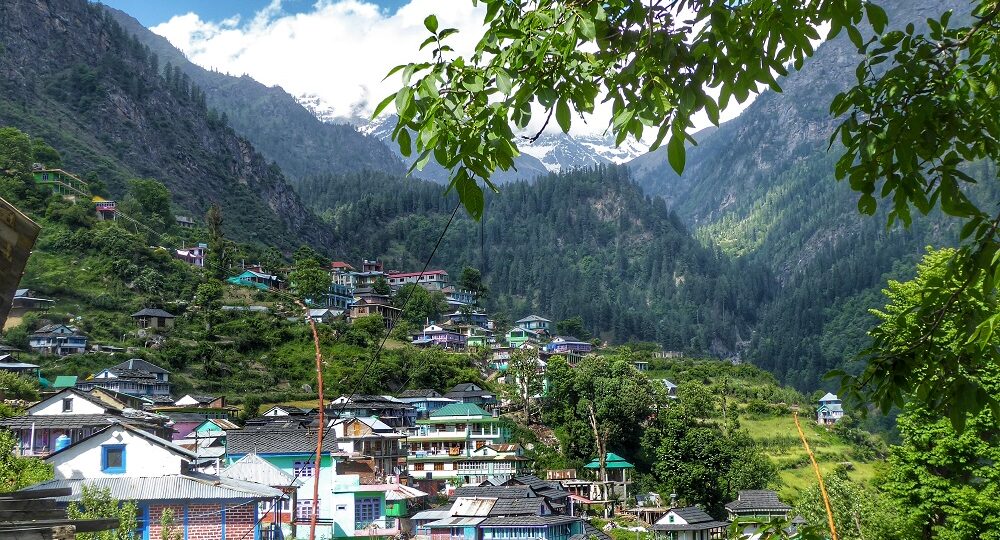
In Uttarakhand’s Chamoli district, Mana — just 3 km from Badrinath — offers the sector’s most compelling story. Sitting at roughly 3,219 metres, Mana has traditionally carried the title of India’s last inhabited village before the Indo-Tibetan border. In a notable recent shift, authorities have begun repositioning it as the “First Village of India” — the same location and community, framed with a more welcoming narrative. Mana’s Bhotiya residents maintain a distinct dialect and Tibetan-influenced architecture, and the village serves as the gateway to mythological sites including Vyas Gufa and Vasundhara Falls.
Suggested 6-Day Itinerary
| Day | Route & Activities |
|---|---|
| Day 1 | Arrive Haridwar/Rishikesh; overnight |
| Day 2 | Drive to Joshimath via Rudraprayag and Karnaprayag (9–10 hrs) |
| Day 3 | Continue to Badrinath; temple darshan; overnight Badrinath |
| Day 4 | Day trip to Mana — Vyas Gufa, Bheem Pul, Vasundhara Falls trek |
| Day 5 | Return drive towards Rudraprayag |
| Day 6 | Return to Haridwar/Rishikesh; departure |
Extend by 3–4 days to include a Kinnaur-Spiti circuit for the complete Himachal-Uttarakhand frontier experience.
Tentative Cost Breakdown (Per Person, Group of 4–5)
| Expense Head | Estimated Cost (₹) |
|---|---|
| Cab hire (round trip, 1,000+ km) | 3,500 – 4,500 |
| Hotel/guesthouse accommodation (5 nights) | 7,500 – 12,000 |
| Meals | 2,500 – 3,000 |
| Local guide (optional) | 500 – 1,000 |
| Estimated Total | ₹14,000 – 20,500 |
Best season: May to October | Permit: None for Mana village; restricted zones beyond require special clearance
Sector 4: Punjab Border Belt — Wagah & Ferozepur
Overview
Punjab’s frontier is North India’s most theatrical. Since 1959, the Beating Retreat ceremony at Wagah has been performed every single evening without fail, making it one of the longest continuously running daily military ceremonies in the world. Thousands of spectators gather nightly to watch the elaborately choreographed display of marching, high kicks, and a closing handshake between Indian and Pakistani officers.
Beyond the spectacle, quieter villages near Ferozepur offer an unfiltered look at agricultural life continuing within sight of the border fence — a useful counterpoint for travellers who want more than a single evening’s ceremony.
Suggested 2-Day Itinerary
| Day | Route & Activities |
|---|---|
| Day 1 | Arrive Amritsar; visit the Golden Temple; evening Wagah Border ceremony; overnight Amritsar |
| Day 2 | Day trip to Ferozepur border villages/Hussainiwala; return and departure |
Tentative Cost Breakdown (Per Person, 2D/1N)
| Expense Head | Estimated Cost (₹) |
|---|---|
| Hotel (1 night, budget-mid range) | 1,200 – 2,000 |
| Local cab to Wagah (round trip) | 300 – 500 |
| Ferozepur day trip (shared cab) | 800 – 1,200 |
| Meals | 800 – 1,000 |
| Estimated Total | ₹3,100 – 4,700 |
Best season: Year-round | Permit: None required; free entry
Sector 5: Rajasthan Desert Frontier — Jaisalmer & Barmer
Overview
Rajasthan’s border sector trades mountains for the Thar Desert’s endless dunes. Around Jaisalmer and Barmer, camel caravans, folk performances, and desert camps define the traveller experience — and a genuinely new addition has recently entered the mix. The Border Security Force has begun hosting Wagah-style Beating Retreat ceremonies at desert posts including Babliyan near Jaisalmer, with plans to extend the initiative to Bikaner’s Sanchu and Khajuwala posts, giving this sector its own distinctive border spectacle.
🗺️ Suggested 4-Day Itinerary
| Day | Route & Activities |
|---|---|
| Day 1 | Arrive Jaisalmer; explore Jaisalmer Fort and havelis |
| Day 2 | Sam Sand Dunes — camel safari; overnight desert camp |
| Day 3 | Visit Barmer/border villages; BSF Beating Retreat at Babliyan (subject to schedule); return to Jaisalmer |
| Day 4 | Local sightseeing and shopping; departure |
Tentative Cost Breakdown (Per Person, 4D/3N)
| Expense Head | Estimated Cost (₹) |
|---|---|
| Hotel/guesthouse (2 nights, city) | 2,500 – 4,000 |
| Desert camp with meals (1 night) | 2,500 – 4,000 |
| Camel safari and jeep transfers | 1,500 – 2,000 |
| Local sightseeing and meals | 2,000 – 2,500 |
| Estimated Total | ₹8,500 – 12,500 |
Best season: October to March | Permit: BSF clearance may be required for specific border-post visits
All costs listed are tentative, per-person estimates for shared/group travel at budget-to-mid-range comfort levels, based on 2026 pricing. Actual costs vary with season, group size, vehicle choice, and tour operator — always reconfirm current rates before booking.
At A Glance: All 5 Sectors Compared
| Sector | Duration | Estimated Cost/Person | Best Season | Permit Required |
|---|---|---|---|---|
| Kashmir (Gurez-Keran-Tangdhar) | 5 Days | ₹10,500 – 15,500 | May – September | Yes |
| Ladakh (Turtuk-Hanle) | 7 Days | ₹19,500 – 26,200 | June – September | Yes |
| Himachal/Uttarakhand (Kinnaur-Spiti-Mana) | 6 Days | ₹14,000 – 20,500 | May – October | Partial |
| Punjab (Wagah-Ferozepur) | 2 Days | ₹3,100 – 4,700 | Year-round | No |
| Rajasthan (Jaisalmer-Barmer) | 4 Days | ₹8,500 – 12,500 | October – March | Partial |
Planning Considerations & Challenges
- Connectivity: Mobile networks are patchy to non-existent across most of these sectors; download offline maps and share your itinerary with family before departing
- Security and permits: Border-adjacent zones require Inner Line Permits or local police/BSF clearance — factor in processing time, which can range from same-day to a few days depending on the region
- Climate: Kashmir and Ladakh see sub-zero winters that close most routes between November and April; Rajasthan’s desert frontier is best avoided in peak summer, when temperatures regularly cross 45°C
- Local guides: Strongly recommended across all five sectors — not just for navigation, but for the cultural and historical context that transforms a scenic drive into a genuinely meaningful visit
Frequently Asked Questions
Q: Which border sector is best for a first-time visitor? A: Punjab’s Wagah-Ferozepur circuit is the easiest entry point — no permits, a short 2-day duration, and a budget under ₹5,000.
Q: Which sector offers the most unique experience? A: Ladakh’s Hanle, for its Dark Sky Reserve status and near-unmatched stargazing, is frequently cited as the most distinctive frontier experience in North India.
Q: Are these border villages safe to visit? A: <cite index=”5-1″>Tourism to these frontier regions has expanded steadily as security coordination and infrastructure have improved</cite>, though travelling with registered local guides and checking current advisories remains recommended for all sectors.
Q: How far in advance should permits be arranged? A: Inner Line Permits for Ladakh and Kashmir’s restricted zones can often be processed within a day through registered agents in Leh or Srinagar, but it’s advisable to begin the process at least 2–3 days before your planned travel date.
Q: Can all five sectors be combined into a single trip? A: Given the geographic spread — from Kashmir to Rajasthan — combining all five into one trip would require several weeks. Most travellers select one or two sectors per journey based on season and interest.
Conclusion
North India’s border villages offer something increasingly rare in contemporary travel: destinations defined by genuine history rather than manufactured novelty. Whether it’s a Kashmiri valley where a river marks the edge of two nations, a Ladakhi village that spent forty years sealed off from the world, a Himalayan hamlet quietly rewriting its own story from “last” to “first,” a Punjab border putting on the same extraordinary ceremony every evening since 1959, or a Rajasthan desert post just beginning to find its own version of that spectacle — each of these five sectors offers a distinct, well-documented, and genuinely rewarding way to experience India at its edges. Plan around the seasonal windows and cost estimates above, secure your permits early, and set out for a side of the country most travellers never see.