By: JKL Travels – KashmirTravels | July 2026
There is a moment in Kashmir that no itinerary can quite prepare you for.
It comes early in the morning.
The sky is still pale. The mountains are only beginning to emerge from the soft light. The waters of Dal Lake appear almost motionless, broken only by the gentle movement of a passing shikara.
You are not in a hotel.
There is no traffic outside your window. No elevator bell. No corridor full of strangers.
Instead, there is water.
There are mountains.
There is silence.
And somewhere nearby, a boatman is quietly beginning another day on one of India’s most iconic lakes.
Then comes a knock on the door.
A steaming cup of Kashmiri kahwa arrives.
The fragrance of saffron, cardamom and spices fills the room.
You step outside onto the wooden deck of your houseboat, cup in hand, and look across Dal Lake.
This is the moment when you realise that a houseboat stay in Kashmir is not simply another place to sleep.
It is the destination itself.
For generations, these floating homes have formed part of Srinagar’s identity. Today, they remain among the most distinctive accommodation experiences in India, offering travellers something that even the finest conventional hotel struggles to recreate: the feeling of living on the lake.
A Houseboat Is Not Just a Hotel Room Floating on Water
The first thing to understand about a Kashmiri houseboat is that it should not be compared too closely with a modern hotel.
A hotel is designed for efficiency.
A houseboat is designed for atmosphere.
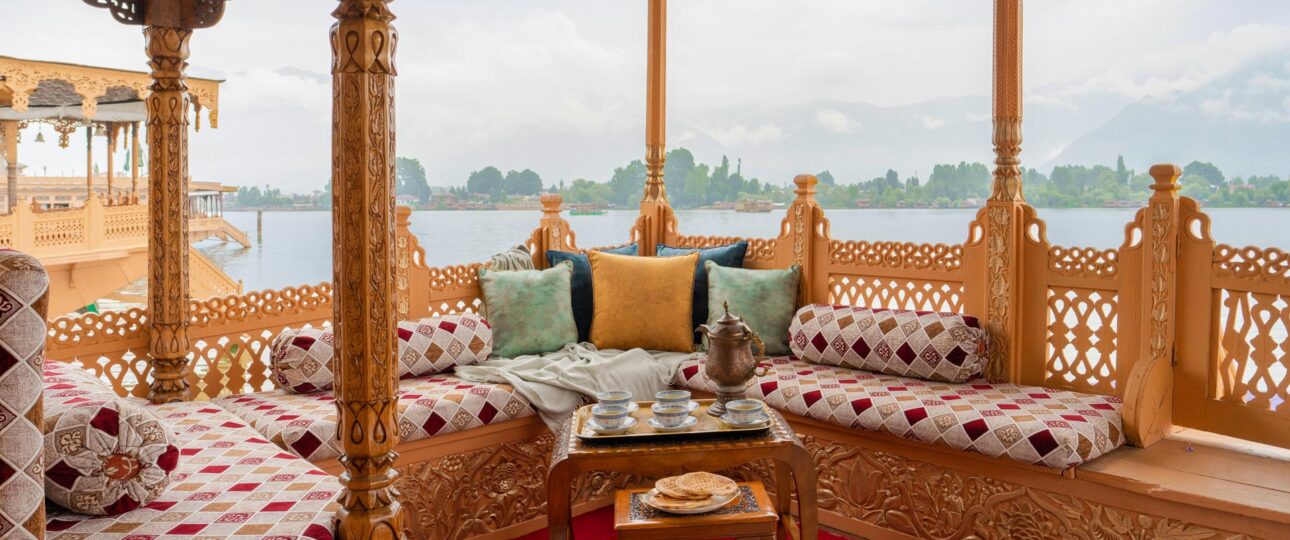
Many traditional houseboats are built with extensive use of wood and feature carved interiors, Kashmiri carpets, embroidered furnishings and traditional decorative elements. Depending on the property, the accommodation may include bedrooms, a drawing room, dining area and a veranda or deck overlooking the lake.
Some are beautifully restored and maintained.
Others are older and more basic.
That contrast is part of the experience—but it also means travellers need to choose carefully.
The phrase “houseboat stay” covers a wide range of experiences, from simple family-run accommodation to highly polished heritage properties offering premium rooms, private dining and curated experiences.
So, before booking, don’t ask only:
“How much does the houseboat cost?”
Ask:
“What kind of houseboat experience am I actually buying?”
That single question can make the difference between an unforgettable Kashmir memory and a disappointing stay.
The Story of Kashmir’s Houseboats Is More Interesting Than the Popular Legend
Ask many travellers why Kashmir has houseboats, and you will probably hear the same story.
The British wanted to own land in Kashmir.
The Maharaja did not allow them to do so.
So they took to the water.
It is a story that has been repeated for decades—but the real history is more complicated.
The development of the modern tourist houseboat is closely connected to restrictions on European land ownership during the Dogra period. Colonial-era visitors increasingly used boats as temporary residences, helping establish a culture of living on the water.
The year 1888 is frequently cited in historical accounts in connection with the first recorded houseboat. However, the story does not begin and end there.
Recent research has drawn attention to Kashmir’s indigenous doonga, a traditional type of boat that predates the modern tourist houseboat. The houseboat tradition therefore appears to have developed through an interaction between local boat-building knowledge, existing water-based lifestyles and the growing demand for accommodation among visitors.
This is an important distinction.
The Kashmiri houseboat was not simply something imported from the West.
Its story is also a story of Kashmiri craftsmanship adapting to a changing world.
And that is precisely what makes it culturally fascinating.
Step Inside: Where Walnut Wood Meets Kashmiri Hospitality
Walk into a traditional houseboat and the first thing you may notice is the wood.
Look closer, and you begin to notice the details.
A carved panel.
A patterned carpet.
A traditional piece of furniture.
Embroidered cushions.
A decorative ceiling.
A window opening toward the lake.
The interiors can feel like a cross between a heritage home and a floating retreat.
Some houseboats showcase intricate Kashmiri wood craftsmanship, while others lean more heavily toward modern hotel-style interiors.
The personality of each boat can therefore be completely different.
That is one of the joys of the experience.
Two houseboats may sit only a short distance apart but offer completely different atmospheres.
One may feel intimate and traditional.
Another may feel grand and luxurious.
A third may be simple, quiet and family-run.
The trick is to find the one that matches your expectations.
The Magic Begins Before You Reach Your Room
For many travellers, the houseboat experience starts at the ghat.
You leave your vehicle.
Your luggage is transferred.
You step into a shikara.
The boatman begins rowing.
The city slowly recedes.
The sound of traffic becomes distant.
The water opens around you.
And suddenly, the journey to your accommodation becomes part of the holiday.
This is one reason the houseboat experience feels fundamentally different from checking into a hotel.
You do not simply arrive.
You cross the lake to get there.
Depending on the location and booking arrangement, shikara transfers may be included or charged separately. Always confirm this before arrival, particularly if you are travelling with heavy luggage or elderly family members.
Then Comes the Morning You Will Remember
The most beautiful part of a Dal Lake houseboat stay may not be the afternoon sightseeing.
It may be the first hour after sunrise.
The lake changes character throughout the day.
Early morning can be peaceful and atmospheric. As the day progresses, the waterways become more active. Shikaras move between destinations, local vendors appear and tourists begin exploring the lake.
But early morning belongs to the lake itself.
This is when you can sit quietly with a cup of kahwa and watch Srinagar wake up.
Kahwa is traditionally associated with Kashmiri hospitality and is commonly prepared using green tea, spices and ingredients such as saffron and cardamom, often accompanied by almonds depending on the preparation.
It is more than a beverage in this setting.
It becomes part of the ritual.
A warm cup.
Cold morning air.
Still water.
Snow-covered or forested mountains in the distance, depending on the season.
And nowhere you urgently need to be.
What Does Breakfast Look Like on a Kashmir Houseboat?
Breakfast varies from property to property.
Some houseboats serve a relatively familiar continental or North Indian breakfast.
Others may offer local Kashmiri breads and traditional accompaniments.
If food is an important part of your travel experience, speak to the houseboat operator before booking.
Ask specifically:
- Is breakfast included?
- Is Kashmiri food available?
- Can vegetarian meals be arranged?
- Can dietary restrictions be accommodated?
- Is dinner available on board?
- Is room service provided?
The best culinary experiences often come when travellers communicate their preferences in advance rather than assuming every houseboat operates like a full-service hotel.
Your Day on Dal Lake: There Is More to Do Than Take a Shikara Ride
The houseboat should be your base—not your entire itinerary.
Srinagar offers a rich combination of history, gardens, crafts, food and water-based experiences.
Start With a Shikara
A shikara ride is the obvious choice, but it deserves more than a quick tick on a sightseeing checklist.
Take your time.
Watch life unfold around the lake.
Depending on the route and season, you may see floating gardens, vendors, boats carrying flowers and vegetables, and the everyday rhythm of people whose lives are connected to the water.
Dal Lake’s floating gardens and water-based culture are among the features highlighted by India’s official tourism information.
If possible, consider taking one ride early in the morning and another around sunset.
They can feel like two completely different experiences.
Explore Srinagar’s Mughal Gardens
From Dal Lake, you can explore Srinagar’s famous Mughal-era gardens.
Consider visiting:
- Nishat Bagh
- Shalimar Bagh
- Chashme Shahi
These gardens offer a beautiful combination of terraces, water channels, landscaped greenery and mountain views.
They are particularly rewarding for travellers interested in photography.
Explore Kashmir’s Craft Heritage
A Kashmir trip is incomplete for many visitors without exploring its craft traditions.
Depending on your interests, you may come across:
- Pashmina
- Kashmiri carpets
- Walnut wood carving
- Papier-mâché
- Embroidery
- Traditional textiles
Be careful with expensive purchases.
Ask for authenticity certificates where relevant, compare prices and buy from established sellers.
The goal should be to take home a piece of Kashmiri craftsmanship—not simply the cheapest souvenir.
How Much Does a Dal Lake Houseboat Stay Cost in 2026?
There is no single fixed price.
Rates can change significantly according to:
- Travel season
- Houseboat category
- Location
- Room size
- Meal plan
- Heating
- Bathroom facilities
- Shikara transfer
- Weekend demand
- Holidays
- Local tourism demand
Online booking listings show a broad range of prices, with basic and mid-range properties often available at lower rates and premium properties costing substantially more. As a practical planning guide, travellers may consider $25–$45 per night for basic stays, $45–$80 for comfortable mid-range properties and $80–$150+ for premium experiences, though actual rates can be higher during peak periods and should be confirmed directly before booking.
Indicative 2026 Houseboat Budget
| Category | Approx. Cost Per Room/Night | Experience |
|---|---|---|
| Basic | $25–$45 | Simple, traditional |
| Mid-range | $45–$80 | Comfortable and scenic |
| Premium | $80–$150 | Heritage-focused |
| Luxury | $150+ | High-end experience |
Note: These are indicative planning figures, not fixed tariffs. Taxes, meals, transfers and seasonal surcharges may be extra.
Three Kashmir Houseboat Packages to Consider
Package 1: The Dal Lake Weekend
Duration: 3 Days / 2 Nights
Day 1
Arrive in Srinagar.
Transfer to Dal Lake.
Take a shikara to your houseboat.
Check in.
Enjoy a relaxed evening.
Day 2
Wake up early.
Have kahwa and breakfast.
Take a morning shikara ride.
Visit Mughal Gardens.
Return to the houseboat.
Spend the evening at leisure.
Day 3
Breakfast.
Check out.
Explore Srinagar if time permits.
Departure.
Indicative budget: $250–$450 per couple, excluding airfare.
Package 2: Kashmir’s Classic Houseboat Escape
Duration: 5 Days / 4 Nights
Suggested Plan
Night 1: Dal Lake houseboat
Day 2: Dal Lake + Mughal Gardens
Day 3: Gulmarg day trip
Day 4: Pahalgam day trip
Day 5: Departure
Indicative budget: $500–$900 per couple, excluding flights.
This is a good option for first-time visitors who want to combine the houseboat experience with Kashmir’s best-known destinations.
Package 3: The Slow Kashmir Luxury Escape
Duration: 6 Days / 5 Nights
This package is designed for travellers who do not want to rush.
Suggested Stay
- 2 nights premium houseboat
- 2 nights luxury Srinagar hotel
- 1 night premium resort outside Srinagar
Experiences
- Private airport transfer
- Premium houseboat stay
- Private shikara experience
- Mughal Gardens
- Curated Kashmiri meal
- Private sightseeing
- One mountain destination
- Leisure time
Indicative budget: $900–$1,800+ per couple, excluding airfare.
For luxury travellers, the cost can rise considerably depending on the property and vehicle category.
The Perfect 5-Day Kashmir Houseboat Itinerary
Day 1: Let the Lake Welcome You
Arrive in Srinagar.
Don’t immediately fill your day with sightseeing.
Check into your houseboat.
Have tea.
Walk onto the deck.
Watch the lake.
Let your first evening be slow.
Day 2: See Dal Lake From the Water
Wake early.
Enjoy kahwa.
Take a shikara ride.
Explore the waterways.
Return for breakfast.
Spend the afternoon exploring Srinagar’s gardens.
Come back before sunset.
Day 3: The Mughal Side of Srinagar
Visit Nishat Bagh, Shalimar Bagh and Chashme Shahi.
Take your time.
Avoid treating the gardens as a race.
Return to your houseboat and enjoy the evening.
Day 4: Into the Mountains
Choose one destination.
Gulmarg.
Pahalgam.
Sonamarg.
Don’t attempt to cover all three.
Kashmir rewards slow travel.
Day 5: One Last Kahwa
Have breakfast.
Take one final look at the lake.
Check out.
If your departure time permits, explore a local market or craft centre.
Then leave Srinagar with the feeling that you have experienced something more than a hotel stay.
When Should You Stay on a Dal Lake Houseboat?
April to June: The Classic Season
Pleasant weather, greenery and strong tourism demand make this a popular period.
Expect prices to rise during peak travel periods.
July to September: A Quieter Option
Weather can be pleasant, but Himalayan weather conditions can change quickly.
Check local forecasts before planning day trips.
October to November: For Autumn Lovers
This is an excellent period for photographers and travellers who enjoy cooler weather and seasonal colours.
December to February: The Winter Experience
Winter offers a completely different Kashmir.
But heating becomes critical.
Before booking, confirm:
- Room heating
- Hot water
- Power backup
- Accessibility during cold weather
The Houseboat Booking Checklist Every Traveller Should Follow
Before paying, ask for clear answers to these questions.
01. Is the bathroom attached?
Never assume.
02. Is hot water available 24 hours?
Especially important in winter.
03. Is heating included?
Ask exactly what type of heating is provided.
04. Is breakfast included?
Confirm the meal plan.
05. Is the shikara transfer included?
Check both arrival and departure transfers.
06. Is the houseboat stationary?
Most tourist houseboats are accommodation units rather than cruising vessels.
07. How far is it from the nearest road?
This matters when travelling with elderly guests or heavy luggage.
08. Are recent photographs available?
Ask for current images, not only promotional photographs.
09. What do recent guests say?
Read the latest reviews.
10. What is the cancellation policy?
Weather and travel conditions can occasionally disrupt plans.
Houseboat or Hotel? The Smartest Choice May Be Both
This is not necessarily an either-or decision.
For most visitors, the best Kashmir accommodation strategy is:
Houseboat + Hotel
Spend one or two nights on Dal Lake.
Then move to a hotel or resort for the rest of your trip.
This gives you two different experiences.
The houseboat provides:
- Heritage
- Atmosphere
- Water views
- Traditional interiors
- A unique cultural experience
The hotel provides:
- Easier road access
- More predictable facilities
- Modern bathrooms
- Larger common areas
- Better convenience for day trips
Together, they create a more balanced holiday.
The Hidden Challenge Behind Kashmir’s Houseboat Romance
The picture of Dal Lake is beautiful.
But behind the postcard image is a more complicated reality.
Traditional houseboats require maintenance.
Their wooden structures age.
Skilled craftsmen are becoming harder to find.
Environmental pressures affect the lake ecosystem.
And regulations surrounding construction, renovation and the future of houseboats have become important issues for the industry.
A 2025 Indian Express report highlighted concerns about the decline of traditional houseboat-building skills and the difficulties involved in maintaining the craft, including access to suitable deodar wood. Researchers have also documented the risk of traditional boat-building knowledge being lost.
This means the houseboat is not merely a tourist attraction.
It is part of a living heritage.
And its survival depends on finding a sustainable balance between:
Tourism + Tradition + Environment + Local Livelihoods
That is why responsible travellers should treat the lake and its communities with respect.
How to Be a Responsible Dal Lake Traveller
A memorable trip should leave behind good memories—not additional problems.
During your stay:
- Avoid throwing plastic into the lake.
- Carry reusable water bottles where practical.
- Do not litter from shikaras.
- Respect local residents.
- Ask before photographing people closely.
- Avoid damaging wooden interiors.
- Use water thoughtfully.
- Support genuine local artisans.
- Follow local tourism and environmental regulations.
A beautiful destination remains beautiful only when visitors help protect it.
Things to Know Before Booking a Kashmir Houseboat
Is a houseboat stay really worth it?
Yes. It is one of the most distinctive experiences in Srinagar.
How many nights should I stay?
One or two nights are ideal for most first-time visitors.
Is a houseboat better than a hotel?
For experience, yes. For convenience, not always.
Can families stay on houseboats?
Yes, but confirm room configuration and bathroom arrangements.
Are houseboats suitable for senior citizens?
They can be, but access via ghats and shikaras should be considered.
Is breakfast included?
It depends on the property.
Is a shikara ride included?
Not always.
Can I get authentic Kashmiri food?
Many properties can arrange it, but ask beforehand.
Is winter a good time?
Yes, if the houseboat has adequate heating and hot water.
Are houseboats safe?
Choose established, well-maintained properties and check recent guest feedback.
Can I work remotely from a houseboat?
Some can accommodate remote work, but internet quality varies. Confirm connectivity before booking.
Is Dal Lake crowded?
During peak periods, yes. Early morning is usually more peaceful.
Can I book directly?
Yes, but compare direct rates with reputable online platforms and verify exactly what is included.
Is one night enough?
Yes, but two nights allow you to enjoy the experience without rushing.
What is the biggest mistake travellers make?
Booking purely on price without checking recent reviews, bathroom facilities, heating and location.
The Real Luxury of a Dal Lake Houseboat Is Time
Kashmir has plenty of luxury hotels.
It has beautiful resorts.
It has modern accommodation.
But none of them can quite reproduce the experience of waking up surrounded by water.
That is the real luxury of a houseboat.
Time.
Time to watch the lake.
Time to drink kahwa slowly.
Time to listen to the sound of an oar touching water.
Time to look at the mountains without taking a photograph every few seconds.
Time to do nothing.
And perhaps that is what makes the traditional Kashmiri houseboat so memorable.
It does not ask you to hurry.
It asks you to stay.
To look.
To listen.
To experience Kashmir at water level.
Final Word: Before You Leave Kashmir, Sleep on the Lake
You can visit Kashmir and stay in a beautiful hotel.
You can drive through mountains.
You can photograph meadows.
You can visit gardens.
You can shop for handicrafts.
But if you spend at least one night on a traditional houseboat on Dal Lake, you experience another side of Srinagar—a slower, quieter and more intimate Kashmir.
The kind of Kashmir that begins with a shikara ride.
Continues with a cup of kahwa.
And ends with the reflection of mountains shimmering on the water.
For first-time visitors, one or two nights on a Dal Lake houseboat is perhaps the perfect introduction to Srinagar’s floating heritage.
Because years later, you may not remember the exact name of your hotel.
But you are very likely to remember waking up on the lake.
And that first cup of kahwa.
With the mountains watching from a distance.
Editor’s Fact-Check & Publishing Note
The historical section has been intentionally written with nuance rather than repeating the simplified claim that British visitors “invented” houseboats solely because they were prohibited from owning land. Historical reporting connects the modern houseboat tradition to restrictions on European land ownership and the growth of tourism, while more recent research emphasizes the role of indigenous doonga boats and Kashmiri boat-building traditions. The 1888 date is frequently cited for the first recorded houseboat, but the wider history of floating residences and local boat culture is older and more complex.
The cost figures in this article are indicative planning estimates for 2026, not guaranteed tariffs. Live prices should be reconfirmed with individual properties before publication or booking. Online listings demonstrate significant price variation based on dates, property category and inclusions.