Kashmir vs Ladakh Honeymoon: An In-Depth Guide to India’s Two Greatest Himalayan Love Stories
By: JKL Travels – Kashmir Travels | July 2026
A field-tested, fact-checked look at what actually waits for you in each valley — written for couples who want more than a brochure.
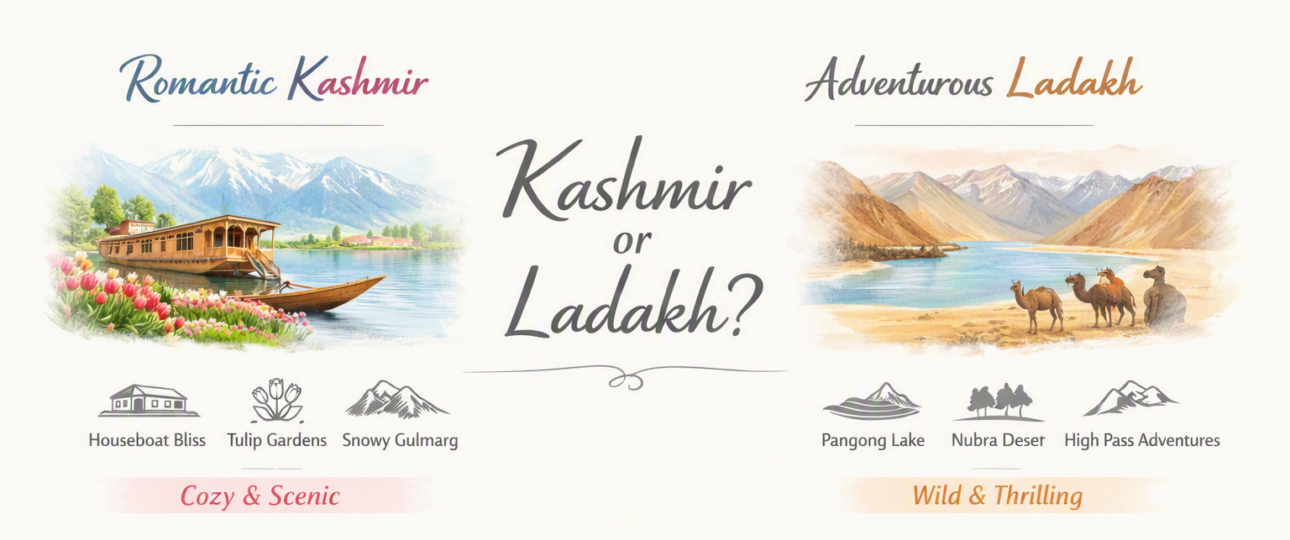
Every year, thousands of newly married couples stand at the same fork in the road: fly north to Srinagar, or fly further north to Leh. On paper, the two look interchangeable — both promise “the Himalayas,” both show up in the same Pinterest boards, both get filed under “honeymoon in Kashmir/Ladakh” in a hundred travel blogs that rarely explain what actually separates them.
They should not be filed together. Kashmir and Ladakh are separated by more than distance — by altitude, by climate, by the entire emotional register of the trip. This piece exists to actually explain that difference, in enough operational detail that you can plan around it, before JKL Travels turns it into a real itinerary for you.
The Geography Nobody Explains Properly
Srinagar, Kashmir’s summer capital, sits at roughly 1,730 metres above sea level — comfortable, temperate, and easy on the body from the moment you land. Leh, Ladakh’s capital, sits at close to 3,500 metres — more than double the altitude — which is exactly why the two trips feel so different before you’ve even left the airport.
This isn’t a minor technicality. It’s the single most important planning fact in this entire article: Ladakh requires acclimatization, Kashmir does not. Couples who skip this step in Ladakh often spend their first precious day fighting headaches and nausea instead of falling in love with the landscape. We’ll come back to this.
Kashmir, Slowly: A Region Built Around Stillness
There’s a specific kind of romance that only works when nobody’s in a hurry, and Kashmir has built its entire tourism identity around exactly that pace.
The Dal Lake Candlelight Dinner — What Actually Happens
The shikara — Kashmir’s iconic flat-bottomed wooden boat — is rowed, not motored, which means your candlelit dinner on Dal Lake unfolds in near-total silence, broken only by the oar dipping into water and the occasional call of a bird settling for the night. Operators typically decorate the boat with fairy lights and fresh flowers, and the meal itself usually leans on Kashmiri Wazwan traditions — rista, rogan josh, and saffron-infused rice among the dishes couples request most. The backdrop shifts as you drift: the Mughal-era Nishat Bagh and Shalimar Bagh gardens, lit at dusk, sit right along the lake’s edge, and most boatmen know exactly when to time your dinner so you pass them at their best.
Houseboats — Not All Categories Are Equal
Kashmir’s houseboats are graded, much like hotels, from Deluxe to Super Deluxe to Luxury/5-Star equivalents. The higher categories feature hand-carved Kashmiri walnut-wood interiors, heated rooms (essential outside peak summer), attached bathrooms with hot water, and a dedicated caretaker who handles everything from meals to housekeeping. For a honeymoon, most consultants — JKL Travels included — recommend at minimum a Deluxe category houseboat, since the jump in comfort relative to cost is significant.
Gulmarg — The Numbers Behind the Views
Gulmarg’s Gondola is a genuine engineering landmark, not just a scenic ride. It operates in two phases: Phase 1 lifts you from Gulmarg (around 2,650 m) to Kongdori station, and Phase 2 continues on to Apharwat’s Kongdori shoulder, topping out near 3,950 metres (about 12,960 feet) — making it, by most current rankings, the world’s second-highest operating cable car. In winter (roughly December through February), this altitude translates into serious snowfall and skiable terrain; couples not interested in skiing can simply ride up for the view and a cup of hot kahwa at the top. In the warmer months, the same slopes turn into wildflower meadows, and the ride becomes more about the panorama — including distant views toward the Nanga Parbat range on clear days — than the snow.
Pahalgam — The Quiet Half of the Trip
Pahalgam sits along the Lidder River at a gentler altitude than Gulmarg, and it plays a very different role in the itinerary: it’s where the trip slows down even further. Riverside cottages, short walks to Betaab Valley (named after the Bollywood film shot there) and Aru Valley, and simply the sound of the river running past your window make Pahalgam the part of a Kashmir honeymoon couples most often describe as “the one we didn’t want to leave.”
Ladakh, Vividly: A Region Built Around Scale
If Kashmir asks you to slow down, Ladakh asks you to look up — at mountains, at passes, at a night sky unlike anything most travelers have seen. It is also, frankly, a more demanding trip logistically, and any honest guide should say so plainly.
The Altitude Reality — And How to Handle It
Leh sits at approximately 3,500 metres. From there, most itineraries push higher still: Khardung La, the road pass connecting Leh to Nubra Valley, sits at an officially surveyed 5,359 metres (17,582 feet) — despite roadside signage in Leh popularly (and incorrectly) claiming figures closer to 5,600 metres or “world’s highest motorable road” status, a title that in fact now belongs to Ladakh’s own Umling La. Chang La, the route to Pangong Lake, sits even higher at roughly 5,360 metres. Pangong Lake itself rests at around 4,225–4,350 metres.
What this means practically: Day 1 in Leh should involve no exertion at all. Rest, hydrate, avoid alcohol, and let your body adjust before attempting any pass above 5,000 metres. JKL Travels builds this acclimatization day into every Ladakh itinerary as a non-negotiable, not an optional extra — it is the single biggest factor in whether the trip is enjoyable or exhausting.
Pangong Tso — The Lake Everyone Recognizes But Few Understand
Pangong Tso stretches roughly 134 kilometres in length, with only about a third of it lying inside Indian-administered Ladakh and the rest inside Chinese-administered territory across the Line of Actual Control — a geopolitical detail that surprises many first-time visitors. It’s a saline, endorheic lake (meaning it has no outlet), which is part of why its colour shifts so dramatically through the day — deep blue at midday, softer turquoise at dusk. The lake owes much of its modern fame to Bollywood, but the reality in person is quieter and, most couples say, more moving than any film frame captured it.
Nubra Valley — A Cold Desert That Shouldn’t Exist Where It Does
Reached via Khardung La, Nubra Valley is a genuine geographic anomaly: a sandy, cold desert flanked by snow-capped peaks, home to the double-humped Bactrian camel — a species found almost nowhere else in India, believed to be a legacy of the old Silk Route trade caravans. The camel safari across Hunder’s dunes is equal parts scenic and simply fun, and it’s usually the point in the trip where couples relax most, after the tension of the Khardung La crossing.
The Monasteries — More Than a Photo Stop
Thiksey Monastery, built in a tiered hilltop style often compared to Tibet’s Potala Palace, Hemis Monastery, one of Ladakh’s wealthiest and most historically significant gompas, and Diskit Monastery in Nubra Valley, home to a giant Maitreya Buddha statue overlooking the valley, together form the backbone of Ladakh’s spiritual tourism. Many couples build in a short blessing ceremony at one of these sites — a genuinely quiet, reflective counterpoint to the adrenaline of the mountain passes.
The Sky at Night
This is Ladakh’s least “plannable” but most talked-about experience. With altitude comes thinner, drier air and minimal artificial light, and on a clear night near Pangong or in Nubra Valley, the Milky Way is visible to the naked eye in a way that’s genuinely rare for most travelers to have ever seen. A well-run camp — proper insulated tents, hot meals, warm bedding — turns this into comfort rather than an endurance test, which is why camp quality matters more in Ladakh than almost anywhere else on the itinerary.
Month-by-Month: When to Actually Go
| Month | Kashmir | Ladakh |
|---|---|---|
| Jan–Feb | Snow honeymoon in Gulmarg, cold but magical | Closed / extreme cold, not recommended |
| Mar–Apr | Blossom season, tulip gardens, mild weather | Still largely closed, roads snowbound |
| May–Jun | Pleasant, green, peak tourist season | Opens up — passes clear, ideal window begins |
| Jul–Aug | Warm, occasional rain, lakes at their fullest | Best window — all passes open, warm days |
| Sep | Clear skies, fewer crowds, excellent visibility | Still excellent, cooling nights |
| Oct | Autumn colour (chinar trees turn gold) | Passes beginning to close, camping gets cold |
| Nov–Dec | Cold, early snow possible | Largely inaccessible by road |
Permits, Paperwork, and the Details Brochures Skip
Ladakh requires Inner Line Permits (ILPs) for Nubra Valley, Pangong Lake, and several other border-adjacent zones — these are processed through Leh’s local administration and are typically arranged by your tour operator using copies of your ID. Kashmir, by contrast, requires no special permits for standard tourist circuits like Srinagar, Gulmarg, and Pahalgam. This is one more reason Ladakh itineraries need a slightly longer lead time to book than Kashmir ones — JKL Travels recommends confirming Ladakh travel dates at least 3–4 weeks in advance during peak season (June–August) to avoid permit-processing delays.
Why JKL Travels Handles the Details Most Couples Don’t Think to Ask About
- Personalized Honeymoon Planning – itineraries built around your dates, fitness level, and the pace you actually want, not a generic template.
- Luxury Hotels & Boutique Resorts – from graded Kashmir houseboats to Ladakh’s better-insulated boutique camps, chosen specifically for comfort at altitude or on water.
- Private Transport & Guided Tours – no shared vehicles, no group scheduling — and drivers experienced with high-pass conditions in Ladakh specifically.
- Romantic Surprises & Custom Add-Ons – candlelight setups, cake arrangements, professional photography, and flexible add-ons built into either region’s itinerary.
Detailed Sample Itineraries
Kashmir — 6 Nights / 7 Days (Slightly Extended for Depth)
| Day | Details |
|---|---|
| 1 | Arrive Srinagar, check into houseboat, evening shikara ride on Dal Lake |
| 2 | Mughal Gardens (Nishat, Shalimar, Chashme Shahi), floating market visit at sunrise, candlelight dinner on the lake in the evening |
| 3 | Drive to Gulmarg (~1.5–2 hrs), Gondola Phase 1 & 2, leisure evening at a mountain-view stay |
| 4 | Return toward Pahalgam via Srinagar, check into riverside property |
| 5 | Betaab Valley and Aru Valley excursion, pony ride, riverside picnic |
| 6 | Return to Srinagar, Pashmina and Kashmiri handicraft shopping, farewell dinner |
| 7 | Departure |
Ladakh — 7 Nights / 8 Days (With Full Acclimatization Built In)
| Day | Details |
|---|---|
| 1 | Arrive Leh, complete rest day — no sightseeing, hydration and light walking only |
| 2 | Leh Palace, Shanti Stupa, local market, gentle half-day sightseeing |
| 3 | Magnetic Hill, Sangam Point (Indus-Zanskar confluence), Gurudwara Pathar Sahib |
| 4 | Drive to Nubra Valley via Khardung La, Hunder camel safari, overnight in Nubra |
| 5 | Diskit Monastery, drive to Pangong Lake via Shyok route |
| 6 | Sunrise at Pangong, photoshoot, starlit camping overnight |
| 7 | Return to Leh via Chang La, Thiksey and Hemis Monastery visit en route |
| 8 | Departure |
Combined Kashmir + Ladakh — 12 Nights / 13 Days
For couples with the time, this pairing genuinely delivers “two honeymoons in one” — the softness of Kashmir bookending or opening into the scale of Ladakh, connected by a short domestic flight (Srinagar–Leh flights run seasonally and are worth booking early).
Tentative Costing (Per Couple, 2026 Season)
| Package | Duration | Standard | Luxury |
|---|---|---|---|
| Kashmir Honeymoon | 6N/7D | ₹40,000 – ₹58,000 | ₹85,000 – ₹1,35,000+ |
| Ladakh Honeymoon | 7N/8D | ₹55,000 – ₹75,000 | ₹1,05,000 – ₹1,70,000+ |
| Kashmir + Ladakh Combo | 12N/13D | ₹95,000 – ₹1,30,000 | ₹1,80,000 – ₹2,80,000+ |
Figures are indicative starting ranges and exclude international/domestic flights unless specified. Ladakh pricing includes standard permit-processing costs; peak-season surcharges may apply for Pangong/Nubra camping in July–August. Final costs are confirmed by JKL Travels after itinerary customization.
FAQ
1. Is Ladakh genuinely riskier health-wise than Kashmir? Not riskier, but more demanding — it requires deliberate acclimatization. Kashmir’s altitude (roughly 1,700–2,700 m across most of the circuit) causes no such concern for the vast majority of healthy travelers.
2. Can we visit both in one trip without exhausting ourselves? Yes, but sequencing matters. Doing Kashmir first, then flying to Leh, is generally more comfortable than the reverse, since your body has already adjusted to cooler mountain air before tackling Ladakh’s altitude.
3. What should we actually pack for Ladakh that we might not think of? Lip balm and moisturizer (the dry air is intense), a basic altitude-sickness medication after consulting a doctor, layered thermal wear even in summer for night camping, and a power bank, since charging points are limited near Pangong and Nubra.
4. Are Kashmir’s houseboats safe and comfortable for a honeymoon? Yes — reputable, licensed houseboats (Deluxe category and above) offer heated rooms, attached bathrooms, and 24-hour caretaker service. JKL Travels only books licensed, inspected houseboats for client stays.
5. How far in advance should Ladakh travel be booked? At least 3–4 weeks ahead in peak season (June–August) to allow time for Inner Line Permit processing and to secure better camp/hotel availability near Pangong.
6. Is Kashmir currently safe for tourism? Kashmir’s tourism circuits — Srinagar, Gulmarg, Pahalgam — see regular, active tourist traffic year-round, and standard travel-advisory precautions apply as they would for any destination. JKL Travels stays updated on current regional conditions before confirming any itinerary.
7. Which destination photographs better for a honeymoon album? Different, not “better” — Kashmir gives soft, green, water-and-garden imagery; Ladakh gives dramatic, stark, big-sky imagery. Many couples choose based on which aesthetic matches their wedding photography style.
8. Do we need travel insurance for either trip? It’s strongly recommended for Ladakh specifically, given the altitude and remoteness of areas like Pangong and Nubra, where medical access is limited.
9. What’s the single biggest planning mistake couples make? Underestimating Ladakh’s acclimatization needs — skipping the rest day to “save time” is the most common regret shared by returning travelers.
10. Can JKL Travels customize either itinerary further? Yes — hotel category, number of days, add-on experiences, and the balance between adventure and relaxation are all adjustable to your specific preferences and budget.
The Bottom Line
There’s no wrong choice between Kashmir and Ladakh — only the right choice for the two of you. If your idea of romance is candlelight, water, and gardens, Kashmir will feel like it was built for your honeymoon specifically. If it’s vastness, altitude, and a sky full of more stars than you’ve ever seen at once, Ladakh will do the same. JKL Travels’ job is simply to make sure whichever one you pick is planned properly — permits sorted, acclimatization respected, and every romantic detail exactly as imagined.
📞 Call / WhatsApp: +91 88033 24365 | +91 97960 24365 📧 Email: info@jkltravels.com
Crafting Dreams, Creating Memories…