Millions of Views, Beautiful Website—But Is Your Kashmir Hotel Booking Really Safe?
By: JKL Travels – Kashmir Travels | September 2026
A beautiful website, thousands of reviews, millions of Instagram views and an attractive holiday package can create instant confidence. But when a family arrives in Kashmir and cannot find the hotel it paid for, one question suddenly becomes more important than followers, likes or digital glamour: Who exactly did you pay?
Srinagar: The holiday had been planned weeks in advance.
Flights were booked. Bags were packed. The Kashmir itinerary looked perfect. The family had a hotel confirmation in hand and presumably believed that one of the most important parts of the journey—where they would sleep after reaching the Valley—was already taken care of.
Then they arrived.
And the hotel they had booked online could not be found.
According to the account supplied for this report, the family discovered that the accommodation mentioned in their booking confirmation could not be located at the stated address. People in the surrounding area reportedly had no knowledge of the property, leaving the tourists searching for alternative accommodation after reaching Kashmir.
What should have been the beginning of a family holiday instead became a scramble for a room.
The reported incident still requires appropriate verification before any individual company, platform or property can be accused of deliberate fraud. But the episode raises a much bigger question—one that applies to practically every tourist booking a holiday online today:
How much should you trust what you see on a screen?
The uncomfortable answer is:
Not as much as you think.
A website can be beautiful.
An Instagram page can have millions of views.
A travel reel can go viral.
A company can display hundreds of testimonials.
A booking confirmation can arrive instantly in your inbox.
And yet none of these things, by themselves, proves that the person selling your holiday is properly registered, that the hotel actually exists, or that the reservation will be honoured when you arrive.
The modern traveller doesn’t need to become suspicious of everyone.
But they do need to become better at checking what is real behind the screen.
Welcome to the Age of the “Digital Holiday”
Travel once began with a phone call to a travel agent, a visit to an office or perhaps a recommendation from a friend.
Today, the entire holiday can be purchased from a smartphone.
You discover Kashmir through Instagram.
You watch a Gulmarg reel on YouTube.
You see a houseboat on Facebook.
You message an agent on WhatsApp.
You receive a PDF itinerary.
You transfer money through UPI.
And within minutes, a five-day holiday appears to be completely organised.
The convenience is undeniable.
But so is the risk of confusing digital presentation with real-world credibility.
The internet allows businesses to appear polished, established and highly popular. That is not inherently suspicious. Genuine travel companies also invest heavily in websites, social media, advertising and professional content.
The problem begins when travellers assume that online appearance itself is proof of legitimacy.
It isn’t.
Millions of Views Are Not a Tourism Licence
This is perhaps the most important lesson for today’s traveller.
A travel page may have:
1.5 million followers.
Or:
20 million reel views.
Or:
50,000 comments.
That demonstrates online reach.
It does not automatically establish:
- Business registration
- Tourism authorisation
- Ownership
- Financial responsibility
- Hotel availability
- Booking validity
- Refund capability
- Local operational capacity
A small local travel company with a modest social-media following can be perfectly legitimate.
A highly visible online business can also experience booking failures or disputes.
Popularity and legitimacy are two different things.
Followers measure attention.
Views measure reach.
Reviews represent customer feedback.
None of them, on its own, is a substitute for checking the actual business and booking.
The New Rule: Verify the Business, Not Just the Website
Instead of asking:
“Does this website look genuine?”
ask:
“Can I independently establish who operates this business?”
Instead of asking:
“How many followers do they have?”
ask:
“Where is their office and what business details can I verify?”
Instead of asking:
“Does the Instagram page have good reviews?”
ask:
“Can the hotel independently confirm my reservation?”
Instead of asking:
“Did they send me a booking PDF?”
ask:
“Does the actual property recognise this booking?”
That change in mindset can make a significant difference.
Kashmir Has a Real Tourism Ecosystem—Use It
Kashmir is not an anonymous destination operating entirely through social media.
There are established hotels, houseboats, transport operators, tour companies, government tourism institutions and regulatory mechanisms.
Jammu & Kashmir Police’s tourist-safety guidance refers to the J&K Registration of Tourist Trade Act and says Tourist Police are posted at important tourist locations to assist visitors. The guidance also addresses complaints relating to issues such as cheating, overcharging, harassment and touting.
The Jammu & Kashmir Tourism Development Corporation also maintains an official travel-agent registration mechanism, with its published process referring to business details, GST and trade-licence information.
The message for tourists is straightforward:
Use the tourism ecosystem as part of your due diligence.
You do not need to become a legal expert.
But you should be comfortable asking a travel company for its business identity, applicable registrations, office details and proper documentation—and then checking important information independently.
Why Working Directly With a Properly Established Local Agent Can Matter
Kashmir is a destination where a holiday involves much more than a hotel room.
A typical itinerary may include:
- Airport transfers
- Hotel check-ins
- Shikara rides
- Houseboat stays
- Gulmarg excursions
- Pahalgam transfers
- Sonamarg trips
- Local sightseeing
- Vehicle coordination
- Seasonal itinerary changes
- Activity arrangements
This is where a genuine local travel operator can offer a practical advantage.
If something changes after arrival, a destination-based team may be able to communicate directly with the hotel, driver, vehicle provider or activity operator.
That does not mean every local agent is automatically trustworthy.
“Local” is not a guarantee.
A local operator should still be identifiable and appropriately registered, with transparent documentation and traceable transactions.
The ideal combination is:
Local presence + verifiable business identity + applicable registration + transparent documentation + confirmed services + traceable payment.
That is much stronger evidence than a large follower count.
Planning Kashmir? Start With the People Behind the Package
If you’re planning a family holiday, honeymoon or customised Kashmir itinerary, consider speaking directly with a destination-based travel company and asking for the complete details before making payment.
Explore Kashmir packages with JKL Travels:
JKL TravelsExplore Kashmir travel services with Kashmir Travels:
Kashmir TravelsWhichever operator you choose, verify the business, confirm the hotel and obtain the terms in writing before paying.
A Fancy Website Can Be Built. A Real Hotel Room Has to Exist.
This is where digital confidence can become misleading.
A website can be redesigned.
A photograph can be reused.
A testimonial can be reproduced.
A social-media account can be professionally managed.
A PDF can be generated within seconds.
A screenshot can be edited.
A location pin can be inaccurate.
Even sophisticated digital communication should therefore be treated as information to be checked—not absolute proof.
The real test happens outside the screen.
Does the business exist?
Does the office exist?
Does the hotel exist?
Does the reservation exist?
Does the payment go to the expected party?
Does somebody answer when you need help?
The real world remains the final verification layer.
The Five-Minute Hotel Call That Could Save Your Holiday
Imagine receiving this confirmation:
Hotel XYZ, Srinagar
Check-in: October 15
Check-out: October 18
Room: Deluxe
Guests: Two Adults + One Child
Before travelling, independently contact the hotel.
Where possible, obtain the hotel’s contact details from an independent source rather than simply using a number supplied by the booking agent.
Ask:
“Could you please confirm whether a reservation exists under my name for these dates?”
If the answer is yes, confirm:
- Room category
- Number of guests
- Check-in and check-out dates
- Meal plan
- Booking status
- Confirmation number
- Whether the hotel is operating normally
That short conversation can establish something a PDF cannot:
The property knows about you.
For an expensive family holiday, that small step can provide considerable peace of mind.
The “Too Good to Be True” Package Problem
Kashmir’s beauty may be priceless.
Hotel rooms, however, are not.
Hotels have operating costs. Vehicles cost money. Drivers cost money. Meals, taxes, sightseeing and seasonal demand all affect the final price.
So when one package is dramatically cheaper than comparable offers, don’t automatically assume you’ve discovered an extraordinary bargain.
Ask:
What exactly is included?
A headline price may exclude:
- Airport transfers
- Meals
- Sightseeing
- Parking
- Tolls
- Activities
- Shikara rides
- Entry tickets
- Taxes
- Driver expenses
A low price isn’t necessarily suspicious.
But an unusually low price should lead to more questions—not faster payment.
The Instagram Trap: When Viral Content Becomes a Substitute for Trust
Travel marketing has changed dramatically.
A spectacular Dal Lake reel can attract enormous engagement.
A snowfall video from Gulmarg can go viral.
A luxury houseboat photograph can make an ordinary package look extraordinary.
But there is a fundamental difference between content popularity and transaction reliability.
A person or page may be excellent at creating Kashmir content without necessarily being the business responsible for delivering your hotel booking.
Before transferring money, ask:
Who owns the business?
What is the business name?
Where is the office?
Who issues the invoice?
Whose account receives the payment?
Who has confirmed the hotel?
Who will handle your trip after you reach Kashmir?
These questions tell you considerably more than a follower count.
The Local-Agent Advantage: Someone Knows the Destination
Imagine your flight arrives late.
The hotel says the room category has changed.
A road journey needs to be rearranged.
A sightseeing plan has to be modified because of local conditions.
A family member needs a different schedule.
These are situations in which local coordination can become valuable.
A genuine destination-based operator may be able to communicate with the relevant suppliers directly.
No travel company can control weather, road conditions, hotel operations or every unexpected event.
But there is an important difference between having:
a local representative who can intervene
and
a social-media account that stops responding when the booking goes wrong.
The Simple Kashmir Booking Check
Instead of giving travellers a dozen overlapping checklists, remember these six questions before making a substantial payment:
1. Who am I paying?
Establish the complete business identity and applicable registration details.
2. Where are they based?
Check the physical office or business address independently.
3. What exactly am I buying?
Get the exact hotel, room category, dates, meals, transport and inclusions in writing.
4. Does the hotel know about my booking?
Independently confirm the reservation.
5. Where is my money going?
Check the payment recipient and retain the transaction record.
6. Who will help me if something goes wrong?
Get a genuine local emergency contact before departure.
If these questions have clear answers, you have substantially more information than a website or Instagram profile alone can provide.
What a Proper Travel Quote Should Tell You
A professional quotation should leave little room for confusion.
| Detail | What the traveller should know |
|---|---|
| Traveller | Names and number of guests |
| Dates | Exact arrival and departure |
| Hotels | Exact property names |
| Room | Category and occupancy |
| Meals | What’s included |
| Transport | Vehicle type and usage |
| Sightseeing | Destinations included |
| Activities | Included or extra |
| Taxes | Included or excluded |
| Payment | Advance and balance |
| Cancellation | Refund conditions |
| Emergency | Local contact |
| Company | Business identity |
The clearer the quotation, the easier it becomes to understand what you are actually purchasing.
What If Someone Says: “Don’t Worry, We Have Millions of Customers”?
That should not end the conversation.
Ask for the documentation.
Ask for the hotel confirmation.
Ask for the invoice.
Ask for the business details.
Ask who will meet you.
Ask who will handle an emergency.
A legitimate business should be able to explain its services without relying entirely on popularity as proof.
“Trust us” is not a verification system.
Don’t Make “Local” Another Buzzword
The word “local” itself can become a marketing tool.
Simply saying:
“We are a local Kashmir company.”
doesn’t answer the important questions.
Local where?
Registered how?
Office where?
Who owns the business?
Which hotel is confirmed?
Who receives the payment?
Who is responsible after arrival?
The strongest local operator isn’t necessarily the one with the loudest marketing.
It is the one that can be identified, contacted, verified and held accountable.
JKL Travels & Kashmir Travels: Direct Destination Coordination
For travellers looking for Kashmir-based holiday planning, JKL Travels and Kashmir Travels are destination-focused travel businesses that market Kashmir itineraries and local travel services.
JKL Travels currently publishes Kashmir packages covering destinations such as Srinagar, Gulmarg, Pahalgam and Sonamarg through its official website. JKL Travels Kashmir packages
As with any travel company, travellers should conduct their own due diligence before making payment.
That principle applies to everyone—including companies mentioned in this article.
Don’t trust a company because an article mentions it. Verify the company yourself.
Choose a Local Contact You Can Actually Reach
For travellers who prefer destination-based coordination, direct communication with a local travel company can make itinerary planning and on-ground coordination simpler.
Plan your Kashmir trip with JKL Travels
Explore Kashmir with Kashmir Travels
Ask for the exact hotel, exact itinerary, exact inclusions, payment terms and emergency contact before confirming.
If the Booking Goes Wrong, Preserve the Evidence
If you arrive in Kashmir and discover that something is wrong with your booking, don’t immediately delete the conversations or advertisements.
Preserve everything.
Keep:
- Booking confirmations
- Invoices
- Payment receipts
- UPI details
- Bank transaction records
- WhatsApp conversations
- Emails
- Website screenshots
- Social-media advertisements
- Hotel listings
- Phone numbers
- Photographs of the property/location
The National Cyber Crime Reporting Portal provides mechanisms for reporting suspicious website URLs, phone numbers, email IDs, WhatsApp/Telegram handles and social-media URLs. For financial cyber fraud, the national helpline is 1930.
If you believe you have encountered deliberate online fraud, report it through the appropriate official channels and retain all supporting evidence.
Already in Kashmir and Something Has Gone Wrong?
First, take care of the immediate problem.
If your family has nowhere to stay, arrange safe accommodation—especially when travelling with children or elderly passengers.
Then document the issue and contact:
- The hotel/property
- The travel company
- The booking platform, if one was involved
- Your bank/payment provider where money is involved
- Local police, where appropriate
- Tourist Police/tourism authorities
- The National Cyber Crime Reporting Portal if the matter involves suspected cyber or financial fraud
J&K Police’s tourist-safety guidance says Tourist Police are deployed at important tourist locations and directs tourists toward relevant tourism authorities for complaints involving matters such as cheating, overcharging, harassment and touting.
A Failed Booking Is Not Automatically a Scam
This distinction is important.
A hotel can genuinely exist but lose a reservation.
A booking platform can transmit incorrect information.
A property can change its name.
A hotel can temporarily close.
An agent can make an administrative mistake.
A reservation failure does not automatically establish deliberate deception.
Therefore, claims of fraud should be based on evidence and investigated by the appropriate authorities.
For travellers, however, the preventive lesson remains simple:
Confirm before you travel.
Don’t Let the Booking Be the Weakest Part of Your Holiday
Kashmir should be about Dal Lake, houseboats, Gulmarg, Pahalgam, Sonamarg, mountain views and family memories—not a frantic search for accommodation after arrival.
If you’re considering a Kashmir package, speak directly with a destination-based operator and insist on clear documentation before payment.
Kashmir holiday packages by JKL Travels
Kashmir travel services by Kashmir Travels
Book the experience—but verify the people delivering it.
The Three Things Digital Popularity Cannot Guarantee
A large online presence can be useful, but it cannot independently guarantee three things.
A real hotel room
Only the property can ultimately confirm your reservation.
A responsible business
Followers don’t establish business identity or registration.
On-ground assistance
A viral Instagram account cannot substitute for a real person who can be contacted when you need help.
That is why smart travel planning combines the convenience of the internet with old-fashioned due diligence.
Four Things You Should Never Sacrifice for a Cheap Package
Documentation
Get the itinerary, invoice and terms in writing.
Verification
Don’t let urgency prevent reasonable checks.
Payment transparency
Know exactly who receives your money.
Accommodation certainty
Confirm the actual hotel—not merely a category such as “3-star” or “premium hotel.”
Book the Destination, Not Just the Advertisement
Kashmir deserves to be experienced slowly.
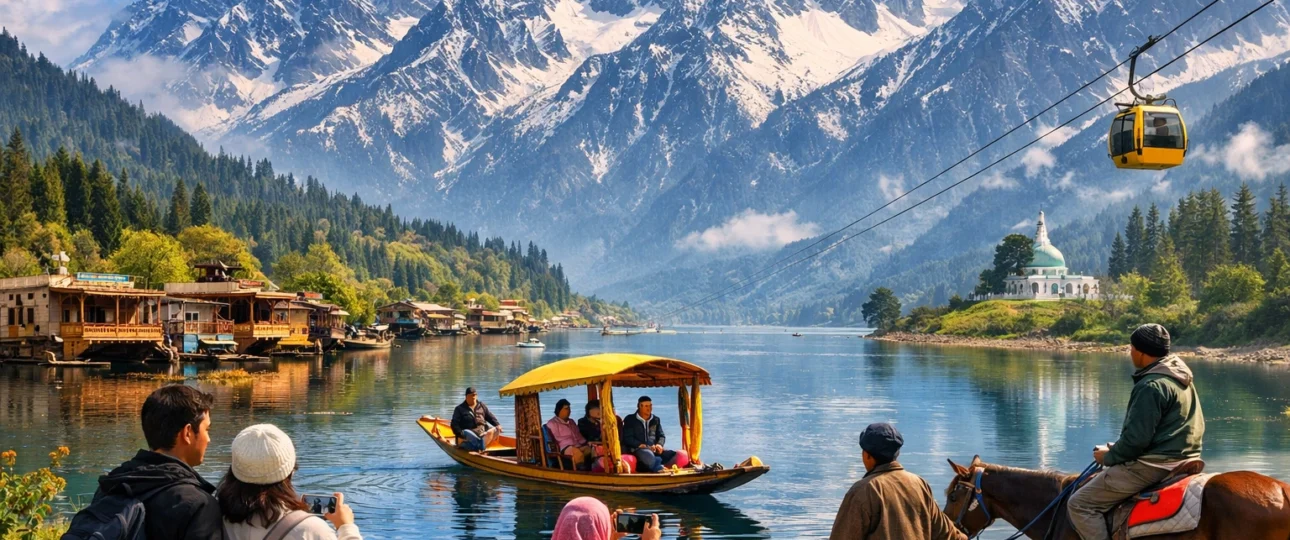
A Shikara gliding across Dal Lake.
A morning among the mountains of Gulmarg.
The rivers and valleys of Pahalgam.
The landscapes of Sonamarg.
A night aboard a traditional houseboat.
But the experience begins long before the flight lands.
It begins with the person who sells you the holiday.
Plan your Kashmir journey with JKL Travels
Verify the business. Confirm the hotel. Read the terms. Keep the receipts. Then pack your bags.
The Bottom Line: Don’t Be Impressed. Be Informed.
The biggest travel mistake in the digital age may not be trusting the wrong person.
It may be trusting the wrong evidence.
A glossy website is evidence of design.
A huge Instagram following is evidence of reach.
A viral video is evidence of engagement.
A five-star rating is evidence that people have posted positive feedback.
But none of these automatically proves that your hotel room exists.
For that, you need something much simpler:
A real business.
A verifiable operator.
A confirmed property.
A traceable payment.
Clear written terms.
A person who can be reached.
The reported family experience may ultimately prove to have been a booking failure, a platform problem, deliberate deception or something else. That determination belongs to the relevant investigation.
But the warning for travellers is already clear.
Before you ask how beautiful Kashmir will be, ask one more question:
“Who exactly is handling my holiday?”
Because when you are hundreds of kilometres from home, the number of Instagram followers behind your booking will not help you find a missing hotel.
A verifiable local business, a confirmed reservation and a real person who answers the phone might.
And that is perhaps the simplest rule for booking travel in 2026:
Don’t just verify the holiday. Verify the people behind it.
Quick Traveller Takeaway
Before paying:
✓ Identify the business
✓ Check applicable registration
✓ Confirm the physical/business address
✓ Get the exact hotel and room details
✓ Verify the payment recipient
After booking:
✓ Obtain the invoice
✓ Confirm the hotel directly
✓ Save payment records and correspondence
Before departure:
✓ Reconfirm the hotel
✓ Reconfirm transport
✓ Keep emergency contacts accessible
If something goes wrong:
✓ Preserve evidence
✓ Contact the hotel, operator and booking platform
✓ Contact your bank/payment provider where appropriate
✓ Report suspected cyber fraud through official channels
National Cyber Crime Helpline: 1930