Hotel or Houseboat in Srinagar? It’s More Than a Room — It’s a Choice of Experience
By: JKL Travels – Kashmir Travels | September 2026
There are some travel decisions that are really about convenience.
And then there are decisions that change the character of the entire holiday.
Hotel or houseboat in Srinagar?
At first glance, it sounds like a straightforward accommodation question. But in Kashmir, the answer can shape how you wake up, how you spend your evenings and even how you remember the destination years later.
A hotel may give you the familiarity of modern accommodation: road access, conventional bathrooms, reception services, restaurants, parking and predictable routines.
A houseboat offers something entirely different.
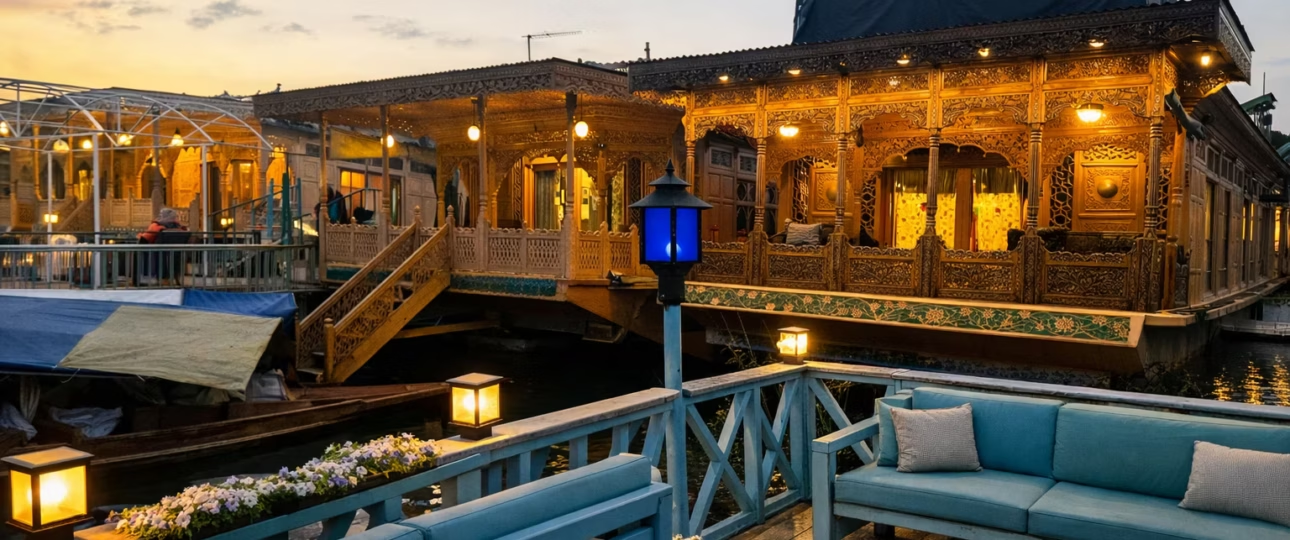
Imagine waking to rippling water instead of traffic. A Shikara gliding past your window. Mountains reflected on the lake. Carved cedarwood panels inside the room. A quiet breakfast on a wooden deck.
That is why the Srinagar houseboat experience remains one of Kashmir’s most recognisable travel experiences.
Official tourism material continues to describe Dal Lake as central to Srinagar’s tourism landscape, with houseboats, Shikaras, floating gardens and waterways forming an important part of the city’s identity.
But there is an important catch:
Not every hotel is the same. Not every houseboat is the same. And the cheapest option is not automatically the best value.
So, what should you actually book?
Hotel vs Houseboat in Srinagar: The Quick Answer
If your priority is modern comfort, easy road access and predictable facilities, a hotel is likely to fit your travel style better.
If your priority is atmosphere, lake views, traditional craftsmanship and a distinctly Kashmiri experience, a houseboat may be more appealing.
And for many first-time visitors, there is a third possibility:
Book both.
Two nights in a hotel can provide a convenient base for sightseeing, followed by one night on a houseboat for the experience.
That combination can give travellers the practical side of Srinagar and the romantic, cultural side of life on the lake.
Why Srinagar’s Accommodation Choice Matters
Srinagar is not simply a gateway to Gulmarg and Pahalgam.
The city itself has a layered personality.
There is the Boulevard along Dal Lake. There are Mughal gardens climbing toward the Zabarwan foothills. There is the old city around the Jhelum, historic mosques and traditional markets. There are craft traditions, floating gardens, Shikaras and waterways.
J&K Tourism Development Corporation lists Dal Lake, Nigeen Lake, Pari Mahal, Mughal Gardens, Hari Parbat, Shah-e-Hamdan and Jamia Masjid among Srinagar’s attractions.
That means your accommodation can either be:
a base from which you explore Srinagar
or
one of the experiences you came to Srinagar to experience.
A conventional hotel generally plays the first role.
A houseboat often plays the second.
Plan Your Jammu, Kashmir & Ladakh Holiday With JKL Travels
Whether you want a classic Srinagar houseboat stay, a comfortable city hotel or a complete Jammu–Kashmir–Ladakh itinerary, the right package should balance accommodation, transfers, sightseeing and time on the road.
From Srinagar–Gulmarg–Pahalgam escapes to longer Himalayan journeys covering Jammu, Kashmir and Ladakh, JKL Travels can help turn the basic destination list into a practical holiday plan.
Ready to plan your Kashmir escape?
Staying in a Srinagar Hotel: Comfort First
Hotels remain the straightforward option for travellers who want accommodation to be easy and functional.
Depending on the property and category, hotels can offer private bathrooms, heating, Wi-Fi, restaurants, room service, parking and conventional front-desk assistance.
Of course, these facilities should never be assumed simply because a property calls itself a hotel. They vary by establishment and room category.
Why a hotel can make sense
1. Easier road access
If your Kashmir itinerary involves several road journeys, accessibility matters.
A vehicle can generally reach a hotel much more directly than a houseboat located on a lake.
That can be particularly useful for:
- Families with young children
- Older travellers
- Guests with mobility concerns
- Travellers with heavy luggage
- Visitors leaving early for Gulmarg or Pahalgam
2. Familiar facilities
A hotel follows a familiar accommodation model.
You check in, enter your room, use the hotel’s facilities and return after sightseeing.
For some travellers, that simplicity is exactly what they want.
3. Better for packed itineraries
Suppose you arrive in Srinagar in the afternoon, explore Dal Lake, leave early the next morning for Gulmarg and then return late.
Your accommodation becomes primarily a convenient base.
In that situation, a hotel may make more practical sense than choosing accommodation mainly for its novelty.
4. More conventional for business travel
Travellers combining Kashmir with work commitments may prefer a hotel because conventional workspaces, road access, connectivity and business services are easier to find.
Staying on a Srinagar Houseboat: When Accommodation Becomes the Destination
Now change the scene.
The alarm goes off.
You open the curtains.
There is water outside.
A Shikara moves slowly across the lake.
The Zabarwan mountains rise beyond the shoreline.
The room around you carries the smell and texture of carved wood.
Suddenly, your accommodation is no longer simply where you slept.
It is part of the Kashmir experience.
Official Incredible India tourism material describes Srinagar’s houseboats as traditional wooden floating accommodation, commonly associated with cedarwood and intricate Kashmiri woodwork and furnishings.
The experience is particularly associated with Dal Lake and Nigeen Lake, while houseboats have also historically existed on the Jhelum.
The Fascinating History Behind Kashmir Houseboats
The story of Kashmir’s houseboats is more complicated than the familiar one-line explanation that “the British invented them.”
There is a broader history of floating dwellings and boat-dwelling communities in Kashmir.
Research documented by the Endangered Material Knowledge Programme notes that floating dwellings known as Doonga have deep roots in the valley’s waterscape and that the idea that the craft was created primarily for British patrons is an oversimplification.
At the same time, the late 19th century saw the development of the houseboat as a form of accommodation for European visitors who faced restrictions on acquiring land in Kashmir.
A 2025 Srinagar heritage booklet published through Sahapedia describes how European residents developed floating homes during the colonial period because the British were not permitted to purchase land, while local craftsmanship transformed the boats into elaborate floating residences.
Incredible India’s tourism account similarly connects the houseboat tradition with restrictions on British land ownership.
So the more accurate story is this:
Kashmir already had a long relationship with boats and floating life.
The late 19th-century tourism boom helped transform that tradition into the distinctive houseboat culture visitors recognise today.
That distinction matters because the houseboat is not simply a colonial curiosity.
It became something deeply intertwined with Kashmiri craftsmanship, local livelihoods and Srinagar’s tourism identity.
Step Inside a Traditional Kashmir Houseboat
The first thing many visitors notice is the woodwork.
A traditional houseboat can contain a remarkable amount of craftsmanship.
Depending on the vessel, visitors may encounter:
- Carved wooden panels
- Decorative ceilings
- Traditional furnishings
- Embroidered textiles
- Carpets
- Kashmiri decorative motifs
- Wooden verandahs
- Intricate interior detailing
Nagin Lake’s official tourism description specifically highlights houseboats decorated with intricate woodwork, embroidered furnishings and colourful textiles.
A heritage booklet on Srinagar likewise describes houseboats as incorporating Kashmiri woodworking, textiles, papier-mâché and carpets.
This is where a houseboat can become more than accommodation.
It becomes a small showcase of Kashmir’s living craft traditions.
Look at the walls.
Look at the ceiling.
Look at the furniture.
Look at the details around the windows.
For travellers interested in architecture and handicrafts, there is often as much to see inside the boat as outside it.
Kashmir’s Craft Heritage Comes Alive on the Water
A Srinagar houseboat can introduce visitors to several crafts associated with the wider region.
Walnut wood carving
Known for detailed decorative work, walnut carving remains one of Kashmir’s best-known woodcraft traditions.
Papier-mâché
Colourful papier-mâché objects often feature floral, botanical and traditional decorative patterns.
Carpets and textiles
Kashmir’s carpet and textile traditions are closely connected to the region’s artistic identity.
Khatamband
Geometric wooden ceiling work is another distinctive feature associated with traditional Kashmiri interiors.
Not every houseboat will contain all these elements, and quality can vary.
But that variation is precisely why travellers should look beyond the listing photograph.
Ask what the actual property offers.
Dal Lake vs Nigeen Lake: Which Houseboat Location Fits You?
The phrase “Srinagar houseboat” can hide an important detail:
Which lake?
Dal Lake and Nigeen Lake are close to one another, but they offer somewhat different settings.
Dal Lake: The Classic Srinagar Experience
For a first-time visitor, Dal Lake is the obvious starting point.
It is the lake most closely associated with Srinagar’s tourism image: Shikaras, houseboats, floating gardens, mountain views and the Boulevard.
Official tourism sources describe Dal Lake as a major part of Srinagar’s tourism and economy, with a network of waterways, floating gardens and houseboats.
JKTDC also highlights houseboats, Shikaras and floating gardens among the lake’s major attractions.
Dal Lake may suit you if you want:
- A first-time Srinagar experience
- Easy access to major tourist attractions
- Classic houseboat photographs
- Shikara rides
- Floating-market experiences
- Boulevard views
- Mughal Garden access
Nigeen Lake: A Quieter Alternative
Nigeen Lake — also written as Nagin Lake — is interconnected with Dal Lake and sits near the Zabarwan landscape.
JKTDC describes it as an offshoot of Dal Lake, connected by a narrow causeway and surrounded by views of the surrounding hills.
Official tourism material also presents Nagin Lake as a tranquil setting with houseboats and Shikara experiences.
Nigeen may appeal to travellers looking for:
- A quieter lake atmosphere
- A slower pace
- A more secluded-feeling stay
- Photography
- Relaxation
- A lake-focused holiday
It is not necessarily a question of which lake is “better.”
It is about which atmosphere you prefer.
Hotel vs Houseboat in Srinagar: Side-by-Side Comparison
| Feature | Hotel | Houseboat |
|---|---|---|
| Modern facilities | Usually stronger | Varies considerably |
| Road access | Generally easier | Requires lake/ghat access depending on location |
| Lake experience | Depends on property | Central to the experience |
| Traditional ambience | Property dependent | Usually much stronger |
| Privacy | Conventional | Depends on boat/location |
| Parking | Generally easier | May require nearby parking + transfer |
| Families | Often convenient | Can work well if facilities suit |
| Couples | Comfortable | Particularly atmospheric |
| Business travel | Usually practical | Less suited to work-focused trips |
| Cultural character | Property dependent | Often a major part of the stay |
| Photography | Good | Excellent for lake-focused imagery |
| Flexibility | Usually high | Depends on location and boat |
| Best use | Convenient base | Experience-led stay |
Important: These are broad accommodation characteristics, not quality ratings of individual properties.
How Much Does a Srinagar Hotel or Houseboat Cost?
This is one area where travellers should be cautious with generic online articles.
There is no single reliable fixed rate for either hotels or houseboats.
Prices can change with:
- Season
- Demand
- Room category
- Property quality
- Location
- Meal plan
- Heating
- Number of guests
- Holiday periods
- Weekend demand
- Package inclusions
Therefore, the frequently quoted ranges of ₹4,000–₹12,000 for hotels and ₹5,000–₹15,000 for houseboats should be treated only as rough promotional examples, not as guaranteed 2026 market prices.
For a real booking, travellers should request a current quotation.
Before comparing two prices, ask:
- Is breakfast included?
- Is dinner included?
- Are taxes included?
- Is heating included?
- Is hot water available?
- Is Wi-Fi available?
- Is the bathroom attached?
- Is parking available?
- Is the transfer to the houseboat included?
- Is the price per room or per person?
- What cancellation terms apply?
A ₹6,000 stay with breakfast, heating and transfers may be a different proposition from a ₹5,000 stay where everything is extra.
Explore Kashmir & Ladakh With Kashmir Travels
Looking for a customised houseboat stay, honeymoon itinerary, family holiday, budget trip or a longer Kashmir–Ladakh adventure?
Kashmir Travels can help travellers plan accommodation and sightseeing around their preferred travel style.
Whether your dream involves:
a sunrise on Dal Lake, snow in Gulmarg, the valleys of Pahalgam or the high-altitude landscapes of Ladakh, your accommodation should support the experience rather than complicate it.
Start planning your Kashmir journey today.
Reach Kashmir Travels for your customised Jammu, Kashmir & Ladakh trip
Hotel or Houseboat for Couples and Honeymooners?
This is where the houseboat experience can become particularly memorable.
A Shikara ride around sunset, followed by dinner and a quiet evening overlooking the lake, offers a setting that a conventional hotel may struggle to reproduce.
But couples who value luxury facilities may prefer a premium hotel.
The practical solution?
Split the stay.
For example:
2 nights hotel + 1 night houseboat
You get:
Comfort → sightseeing → lake experience
rather than trying to make one accommodation type do everything.
Hotel or Houseboat for Families?
Families need to think beyond photographs.
A houseboat may look spectacular online, but parents should check:
- Room size
- Number of beds
- Attached bathrooms
- Heating
- Hot water
- Access to the boat
- Luggage transfer
- Meal arrangements
- Distance from the road
- Child-friendly facilities
For elderly family members, accessibility deserves particular attention.
For younger families who enjoy experiential travel, a houseboat can become one of the highlights of the trip.
The key is not “houseboat or hotel.”
The key is:
Does this specific property work for our family?
What About Business Travellers?
For business travellers, hotels generally provide the more conventional environment.
If your trip involves:
- Online meetings
- Laptop work
- Multiple road appointments
- Early departures
- Frequent vehicle movement
then practical accessibility may matter more than the novelty of floating accommodation.
A houseboat makes more sense when the objective is to slow down rather than maintain a business schedule.
Hotel or Houseboat in Autumn?
Autumn can be a beautiful period for Srinagar.
The city and surrounding landscape take on a different character as foliage changes, while Dal Lake remains a major attraction throughout the year.
For photographers and leisure travellers, a lake-facing stay can make the changing light and scenery part of the accommodation experience.
The best choice depends on whether you want to spend your evenings:
inside a comfortable hotel
or
watching the lake change colour outside a houseboat window.
What About a Houseboat in Winter?
Winter requires a little more homework.
Do not assume that every houseboat has identical heating, insulation or hot-water arrangements.
Ask specifically about:
- Room heating
- Hot water
- Backup arrangements
- Winter meal service
- Access during cold weather
- Road-to-boat transfer
- Current operating status
Winter conditions can also affect your broader Kashmir itinerary.
If you are travelling specifically for snow, remember that snowfall is weather-dependent. Don’t build an entire holiday around a guaranteed snow experience without checking current conditions.
The Houseboat Industry Has a Bigger Story Behind It
There is another reason travellers should look at houseboats differently in 2026.
The traditional craft itself is facing pressures.
Research published through the Endangered Material Knowledge Programme describes houseboat-building as an endangered craft and notes the environmental pressures surrounding Kashmir’s waterways and restrictions on new houseboat construction.
An Indian Express report in 2025 likewise highlighted concerns around the ageing craft, dwindling numbers of skilled boat-builders and the long-standing restrictions on construction of new houseboats.
This makes the experience more than a tourism photograph.
The houseboat sits at the intersection of:
tourism + craftsmanship + local livelihoods + water ecology + heritage conservation.
That is an important part of the story often missed by accommodation guides.
Why Responsible Tourism Matters on Dal Lake
Dal Lake is not a decorative backdrop created for tourists.
It is a living waterscape supporting residents, boat operators, traders, tourism businesses and other livelihoods.
Official tourism material highlights the lake’s role in local commerce as well as tourism.
So travellers can help by keeping the experience low-impact:
- Avoid littering
- Reduce unnecessary plastic
- Use waste-disposal facilities
- Respect local residents
- Avoid damaging wooden interiors
- Follow boating instructions
- Do not treat the lake as an amusement park
A beautiful photograph is better when the place behind it remains beautiful too.
10 Questions to Ask Before Booking a Kashmir Houseboat
Don’t simply ask:
“How much?”
Ask these instead:
1. What is the exact houseboat name?
2. Which lake is it located on?
Dal or Nigeen?
3. Is the bathroom attached?
4. Is heating available?
5. Is hot water available throughout the day?
6. How do guests reach the boat?
7. Is parking available nearby?
8. Are meals included?
9. Are current photographs available?
10. What do recent guests say?
These questions can prevent many unpleasant surprises.
10 Questions to Ask Before Booking a Srinagar Hotel
Similarly, don’t choose a hotel only by its star rating.
Ask:
- How far is it from Dal Lake?
- Is parking available?
- Is heating available?
- Is breakfast included?
- Is the room centrally heated?
- Is hot water available?
- Does the hotel have a restaurant?
- How easy is airport access?
- What is the cancellation policy?
- Is the quoted rate inclusive of taxes?
Location can matter as much as the room.
A hotel farther from the attractions may look cheaper until you calculate the additional transfer time and transport costs.
The Best of Both Worlds: A Hotel + Houseboat Kashmir Itinerary
For a first visit, a combination stay can be particularly practical.
Day 1 — Arrive in Srinagar
- Airport transfer
- Hotel check-in
- Rest
- Boulevard walk
- Evening Shikara ride
- Overnight hotel
Day 2 — Explore Srinagar
Visit:
- Nishat Bagh
- Shalimar Bagh
- Chashme Shahi
- Pari Mahal
- Dal Lake
The Mughal gardens form an important part of Srinagar’s tourism circuit, and JKTDC lists Nishat, Shalimar and other gardens among the city’s major attractions.
Overnight: Srinagar hotel
Day 3 — Old Srinagar + Houseboat
Spend the day exploring Srinagar’s historic and cultural side.
Then move to your houseboat in the evening.
Enjoy:
- Shikara ride
- Sunset
- Dinner
- Lake views
Overnight: Houseboat
Day 4 — Pahalgam
Drive towards Pahalgam.
Depending on local conditions and the day’s available time, explore areas such as:
- Lidder Valley
- Aru
- Betaab Valley
Overnight: Pahalgam
Day 5 — Gulmarg
Travel towards Gulmarg.
Depending on season, weather and operating conditions, visitors may explore the meadow and consider the Gondola experience.
Overnight: Gulmarg or Srinagar
Day 6 — Departure
Breakfast and transfer to Srinagar airport/railway station.
This is an indicative itinerary. Actual routing should be adapted to flight timings, road conditions, weather, attraction operating schedules and accommodation availability.
A Short 3-Night Kashmir Escape
Don’t have six days?
You can still combine the two accommodation styles.
Day 1
Arrival → hotel → Shikara ride
Day 2
Mughal Gardens → Old Srinagar → houseboat
Day 3
Pahalgam or Gulmarg excursion
Day 4
Breakfast → shopping → departure
The result is a compact introduction to:
lake + heritage + mountains + Kashmiri culture.
Where Should Photographers Stay?
If photography is a major reason for your Kashmir trip, accommodation itself can become part of the shot.
A houseboat offers:
- Reflections
- Shikara movement
- Mountain backgrounds
- Sunrise scenes
- Wooden architectural details
- Floating-life photography
A hotel, meanwhile, may offer:
- Elevated views
- Balconies
- Gardens
- Cityscapes
- More convenient access to multiple shooting locations
Again, it depends on the property.
What Should First-Time Visitors Choose?
Here’s a simple way to think about it.
Choose a hotel if your priority is:
Convenience + comfort + road access + predictable facilities
Choose a houseboat if your priority is:
Atmosphere + lake life + craftsmanship + distinctive Kashmir experience
Choose both if your priority is:
Experiencing Srinagar from more than one perspective.
And for many first-time visitors, that last option is particularly appealing.
Your Srinagar Stay Is Only the Beginning
A Kashmir holiday rarely ends with Srinagar.
The city is often the starting point for a wider journey through:
Gulmarg → Pahalgam → Sonamarg → Doodhpathri → Yusmarg → Jammu → Ladakh
JKTDC’s current destination listings include a broad range of Kashmir destinations including Pahalgam, Gulmarg, Sonamarg, Doodhpathri, Gurez, Yusmarg and others.
That is why accommodation should be planned alongside the complete itinerary.
A hotel may be ideal before a long road journey.
A houseboat may be perfect after a day of sightseeing.
A resort in Gulmarg may make more sense during a snow-focused trip.
And a practical Srinagar hotel may be useful for the final night before an early flight.
The best accommodation is the one that fits the journey around it.
From Dal Lake to Ladakh: Make the Journey Bigger
For travellers with more time, Srinagar can also serve as the opening chapter of a wider Himalayan journey.
Imagine:
Srinagar houseboat → Gulmarg snow → Pahalgam valley → Sonamarg mountains → Leh’s high-altitude landscape.
The accommodation changes.
The landscape changes.
The altitude changes.
But the idea remains the same:
Don’t simply collect destinations. Build a journey.
Planning a multi-destination Himalayan holiday?
Talk to JKL Travels about your Jammu–Kashmir–Ladakh itinerary
Want a personalised Kashmir or Ladakh travel plan?
Contact Kashmir Travels and start planning
Frequently Asked Questions
Is a hotel or houseboat better in Srinagar?
It depends on the traveller. Hotels generally offer a more conventional accommodation experience, while houseboats provide a distinctive lake-based and cultural experience.
Is one night on a houseboat enough?
For many first-time visitors, yes. One night can provide the experience while leaving the rest of the itinerary flexible.
Are all Srinagar houseboats the same?
No. Facilities, location, maintenance, room configuration and service can differ substantially. Check the exact property before booking.
Is Dal Lake or Nigeen Lake better for a houseboat?
Dal Lake is closely associated with the classic Srinagar tourism experience, while Nigeen Lake is often chosen by travellers seeking a quieter setting.
Do houseboats have attached bathrooms?
Many tourist houseboats offer private bathrooms, but travellers should confirm the exact arrangement before booking.
Are houseboats suitable for winter?
They can be, but heating, hot water and winter operating arrangements should be confirmed with the specific property.
Is a houseboat suitable for families?
It can be, provided the accommodation has appropriate sleeping arrangements, bathrooms, heating and access for the family.
Should couples stay on a houseboat?
A houseboat can provide a particularly atmospheric experience for couples, although hotels may offer more conventional luxury facilities.
Can I stay in a hotel and still take a Shikara ride?
Yes. You do not need to sleep on a houseboat to experience Dal Lake.
How many nights should I spend in Srinagar?
Two to three nights can provide a comfortable introduction to Srinagar, particularly when combined with excursions to destinations such as Gulmarg and Pahalgam.
Final Verdict: Hotel, Houseboat — or Both?
The question isn’t really about which accommodation is universally “better.”
It is about what kind of Kashmir memory you want to create.
A hotel can give you the convenience of a comfortable base.
A houseboat can give you the feeling of waking inside the landscape itself.
One is practical.
The other is experiential.
And for travellers who don’t want to choose between the two, there is always the most flexible answer:
Stay in both.
Spend your sightseeing nights in a comfortable Srinagar hotel.
Then move onto the lake.
Let the road disappear.
Listen to the water.
Watch a Shikara glide past.
Look at the carved woodwork around you.
And wake up to the mountains reflected across Dal or Nigeen Lake.
Because in Srinagar, sometimes where you stay isn’t just part of the trip.