Hidden Kashmir.
Time Moves Slowly Here.
Journalist Javid Amin called it the Kashmir that exists quietly beyond the usual travel maps — of forgotten roads, remote villages, hidden meadows and communities that still live close to nature. JKL Travels takes you there.
BEYOND DAL LAKE LIES THE REAL ONE.
Writer Javid Amin put it plainly: Kashmir has always been described through its famous landscapes. But beyond these well-known destinations lies another Kashmir — quieter, deeper and almost untouched by the rush of modern tourism.
The standard Kashmir tour was built for efficiency. Dal Lake, Gulmarg gondola, Pahalgam ponies — destinations that photograph well, sell packages, and handle crowds. What it leaves out is the part of Kashmir that the people who actually live there consider extraordinary.
Lolab Valley’s fruit orchards inspired Muhammad Iqbal to write a poem. Gurez Valley’s Dard-Shin community has maintained a distinct language and architecture for centuries behind a mountain pass that closes with the first winter snow. Bangus Valley’s grasslands in Kupwara district are one of the largest high-altitude meadows in Kashmir — almost entirely unvisited by organised tourism. Chatpal’s deodar forest hides a Gujjar community life that moves to seasonal rhythms unchanged for generations. Tosa Maidan didn’t exist as a tourist destination a decade ago because the army was using it as an artillery range — and in doing so, preserved it perfectly from commercial development.
In 2026, JKL Travels’ Srinagar team has verified access, accommodation options, and road conditions for all of these destinations. This guide is the most complete account of what you will find when you go — and how to get there without the anxiety of planning it alone.
📞 +91 88033 24365 | +91 97960 24365 · 📧 Sales@JKLTravels.com | Sales@KashmirTravels.in · 🌐 JKLTravels.com | KashmirTravels.in
SIX VALLEYS. ONE TRUTH. KASHMIR IS MORE THAN ITS POSTCARDS.
Each one has been overlooked by an industry trained to route travellers to the most commercially convenient destinations. That is precisely why they still offer something the famous circuit cannot: the experience of arriving somewhere that has not yet been arranged for your arrival.
The “Land of Love and Beauty” and “fruit bowl of Jammu & Kashmir.” An oval-shaped sub-valley 26 km long at 5,420 ft in Kupwara district. Three sub-valleys — Potnai, Brunai, Kalaroos. Dense deodar and pine, apple/walnut/apricot orchards, the Lahwal River, mysterious Kalaroos Caves, and Satbaran Rock’s seven ancient door-like engravings. Muhammad Iqbal wrote a poem about this valley.
Hidden in the northern reaches, Bangus feels like a world separated from time. One of Kashmir’s largest high-altitude grassland systems — vast rolling green framed by forested ridges. Himalayan brown bear, snow leopard, and diverse bird species. No hotels. No markets. No arranged experience. The only sounds: breeze, birds, and the movement of streams. For photographers, trekkers, and travellers seeking genuine solitude.
Across Razdan Pass (3,300 m) lies the home of the Dard-Shin people — a community with their own language (Shina), architecture, and traditions preserved for centuries behind a mountain that closes with the first winter snow. The Kishanganga River clear and cold through the valley floor. Habba Khatoon Peak — named after Kashmir’s greatest medieval poet — watching over Dawar town. Not a place to visit. A story to experience.
A forest hamlet of almost excessive beauty in the Shangus area of Anantnag. Dense deodar and pine, apple and walnut orchards, meadow clearings, Gujjar community settlements with their seasonal migration between valley and high pasture. No commercial tourism. One forest rest house and Gujjar homestays. Life here follows a slower rhythm — and that rhythm is the experience itself.
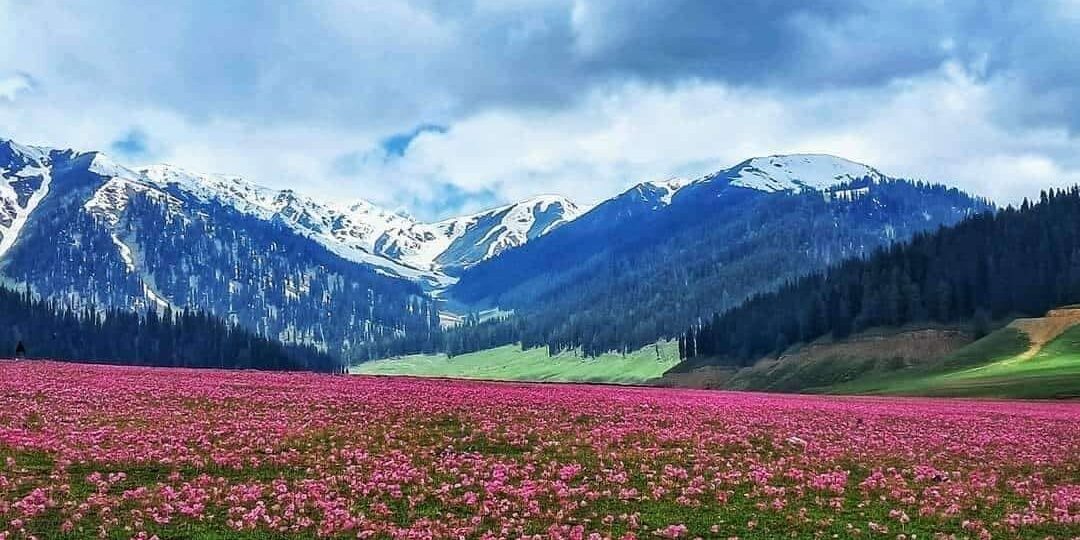
Once an Indian Army artillery firing range — which paradoxically preserved it from any commercial development. Now open to civilians. One of the largest sub-alpine meadows in Asia. No hotels. No vendors. No souvenir stalls. Just a meadow so large it takes 20 minutes to walk to its far edge. Road accessible from Budgam. Also the endpoint of the Doodhpathri-Tosamaidan 6-day trek.
The most accessible offbeat options in this guide. Yusmarg (47 km, 2,400 m) — pine-fringed meadow, pony rides to Nilnag Lake, wide open and quiet. Doodhpathri (55 km) — “Valley of Milk,” milky-white glacial streams through a bowl meadow, starting point of the 6-lake 6-day trek to Tosamaidan. Both reachable by regular car. Both delivering Kashmir’s beauty without a queue in sight.
LOLAB: THE VALLEY IQBAL WROTE A POEM FOR.
When the philosopher-poet Muhammad Iqbal visited Lolab and wrote “O Valley of Lolab!” — celebrating its springs, its morning birds, its light — he was responding to something that 114 kilometres of road from Srinagar still delivers unchanged in 2026.
What the Valley Actually Is
Lolab Valley is an oval-shaped sub-valley 15 miles long with three sub-valleys — Kalaroos, Potnai, and Brunai — at an altitude of 1,590 metres above sea level. It is known as the “fruit bowl of Jammu and Kashmir,” covered with dense forests of Deodar and Pine trees, vibrant apple and walnut orchards, and shaped by the shimmering Lahwal River. Enclosed by fruit orchards and pine forests, the Lahwal River carved out the valley and flows from east to west, home to peaceful settlements and lovely springs.
The three sub-valleys each carry their own character. Potnai is the widest, with the most open meadow landscape. Brunai narrows into denser forest. Kalaroos is where the ancient caves are — and where the valley reveals its most mysterious face. Walking through all three in a single day is not possible. Lolab rewards time, not efficiency.
Kalaroos Caves, Satbaran Rock & Lavnag Spring
You may walk to the fascinating Satbaran Rock, which contains seven engravings that resemble doors but have no known origin. From here, continue walking through the forest to the Kalaroos Caves, once believed to be Russian tunnels. The caves have ancient inscriptions and carvings — their origin is uncertain and their mystery is the point. The 30–45 minute forest walk to reach them is as memorable as the caves themselves.
A three-feet-deep spring called Lavnag can be found nearby. Both Lavnag and Gauri Spring have been well preserved by the Government of Kashmir. Sitting beside Lavnag’s crystal-clear water in the late afternoon, with the forest around you and the valley quiet, is a moment that no luxury resort engineer has yet managed to manufacture.
The Orchard Culture: August–September Harvest
Lolab’s identity as the “fruit bowl of J&K” is not marketing — fruit trees such as apple, cherry, peach, apricot, and walnut are common throughout the valley. The August–September harvest season is the best time to experience this: orchards alive with pickers, the smell of ripe apple in the morning air, local families processing the season’s crop in their yards. JKL Travels arranges orchard immersion visits as part of extended Lolab stays — ask to help for an hour and you will be given more fruit than you can carry home.
A bus takes 2 hours and 30 minutes to cover a distance of 114 km, leading through the towns of Sopore and Kupwara. Private taxi: 2.5 hours from Srinagar. Accommodation: J&K Tourism bungalows and private guesthouses in Chandigam and Kalaroos. Banking services primarily available in Kupwara town — carry cash. Best season: May to August for lush greenery and pleasant temperatures of 13°C to 20°C. August–September adds the harvest experience.
Your springs and lakes with water pulsating and quivering like quicksilver, the morning birds fluttering about the sky — O Valley of Lolab!
Muhammad Iqbal · Poem in Honour of Lolab Valley
Ancient caves with carvings of uncertain origin. Seven door-like engravings on Satbaran Rock with no known explanation. 30–45 min forest walk to reach. The walk is part of the experience.
Three-feet-deep crystal clear spring. Government preserved. Ancient, sacred, and extraordinarily beautiful. The kind of water that explains why people built settlements here.
“The most unforgettable moments often happen between destinations — a roadside tea stall, a conversation with a shepherd, a village elder sharing stories of old trade routes.”
Javid Amin · Hidden Kashmir · 2026
GUREZ: WHERE CULTURE MEETS THE HIMALAYAS. CENTURY BY CENTURY.
Crossing Razdan Pass at 3,300 metres feels like entering another world. And it is. Below the pass, the Dard-Shin community has lived in these mountains for centuries — maintaining a distinct language, architecture, and way of life that survived because the mountain guarded them as much as it isolated them.
The Razdan Pass Drive
The drive from Bandipora to Gurez over Razdan Pass is among the finest mountain drives in Kashmir — switchbacks above the snowline, views across three river systems, the distinct sensation of the valley and its noise falling away behind you as the road climbs. Allow 4–5 hours from Srinagar total. Depart no later than 6 a.m. to cross the pass during the safest daylight window. The pass is open approximately May to October — it closes with the first heavy snowfall, typically in late October, and does not reopen until May.
The Dard-Shin People
The Dard-Shin people of Gurez are among Kashmir’s most distinct communities. Their language, Shina — an ancient Dardic Indo-Aryan language — is spoken by approximately 100,000 people across the India-Pakistan border region. Their traditional wooden architecture (decorative carving markedly different from mainstream Kashmiri styles), their textiles, and their community practices have been preserved by the valley’s historical inaccessibility in ways no museum can replicate. JKL Travels arranges community visits with local Gurez-born guides — a meal, a conversation, a walk through Dawar’s riverside settlement. What happens in these visits cannot be scripted. That is precisely the point.
Habba Khatoon Peak & the Kishanganga
Habba Khatoon — Kashmir’s most celebrated medieval poet, whose tragic love story and lyrical poetry have made her a cultural icon across the valley — has a peak named after her watching over Dawar town. The Kishanganga River runs bright and cold through the valley floor, fed by snowmelt from peaks that touch the Line of Control. The Tulail Valley drive along the Kishanganga from Dawar to Chakwali (the last civilian accessible point) is rated by those who know Gurez as one of the most beautiful valley drives in all of Kashmir.
Indian nationals: register at checkposts with government photo ID — no special ILP generally required, but verify with District Administration Bandipora before travel as regulations can change. Foreign nationals: confirm requirements well in advance. No ATMs in Gurez — carry cash from Bandipora. BSNL network only, patchy beyond Dawar town. Road open May–October only. Pre-book government bungalow or homestay through JKL Travels — walk-in availability not guaranteed. Photography near military installations and the LoC strictly prohibited.
In these forgotten corners of Kashmir, the true meaning of travel becomes clear — sometimes the most beautiful places are not the ones everyone knows, but the ones waiting quietly beyond the map.
Javid Amin · Hidden Kashmir
THE MEADOWS THAT EXIST QUIETLY BEYOND EVERY MAP.
Chatpal’s pine forest hides a Gujjar community life unchanged for generations. Tosa Maidan waited behind army gates for decades. Yusmarg is Srinagar’s quiet neighbourhood meadow. Doodhpathri starts a trek through six high-altitude lakes. None of them appear on standard itineraries. All of them are extraordinary.
Chatpal: Where Tradition Lives in the Forest
About 90 km from Srinagar in the Shangus area of Anantnag, Chatpal is a forest hamlet that rewards the traveller who wants to witness life rather than observe scenery. Dense deodar and pine. Apple and walnut orchards. Meadow clearings. Gujjar settlements — the semi-nomadic community that moves its flocks between valley floor and high pasture according to a seasonal calendar that has governed their lives for as long as anyone can remember. A morning in Chatpal’s forest at 6 a.m., when the mist is still in the trees and the community is beginning its day, is the kind of moment that no curated tourism experience can replicate because it has no ticket and no schedule.
Tosa Maidan: The Meadow That Waited
The Indian Army used Tosa Maidan as an artillery firing range for decades. In doing so, they preserved it. When civilian access was finally opened, travellers found something almost impossible in modern Kashmir: a vast sub-alpine meadow in the Budgam district of the Pir Panjal range with no hotels, no vendors, no souvenir stalls, and no tourism infrastructure of any kind. One of the largest sub-alpine meadows in Asia in an essentially undeveloped state. Accessible by road from Budgam. Also the endpoint of the Doodhpathri-Tosamaidan trek — six days, six high-altitude lakes.
Yusmarg: The Quiet Meadow Within Easy Reach
At 2,400 metres, just 47 km from Srinagar, Yusmarg is what Gulmarg would be if tourism hadn’t found it yet — wide, pine-fringed, green in summer, and genuinely quiet. Pony rides to Sang-e-Safed high pasture and Nilnag Lake. Forest walks. Picnic by the stream. The easiest offbeat option in this guide. The one to add to any Kashmir itinerary as a half-day when you want altitude and meadow without the gondola queue.
Doodhpathri: Where the Milk Streams Begin
Doodhpathri — “Valley of Milk” — takes its name from the milky-white glacial streams (the Shailganga and tributaries) running through a bowl-shaped meadow 55 km from Srinagar. The light in early morning, when mist is still on the water and the meadow is empty, is among the most beautiful in Kashmir. It is also the start of the Doodhpathri-Tosamaidan trek — six days passing through Gurwansar, Pamsar, Bodhsar, Trastar, Navkansar, and Damamsar lakes. Six high-altitude lakes that would individually be the highlight of any other trek in the region. Through JKL Travels: ₹16,000–22,000 per person including guide, camping, and all meals.
Limited mobile connectivity (BSNL most reliable). No ATMs outside district towns — carry cash. Basic accommodation (rest houses, homestays). Bangus and Chatpal require 4×4. Food is local, simple, and usually excellent. These are not inconveniences. They are the experience — and the reason these valleys are still worth visiting.
Kashmir’s beauty does not exist only in its mountains and valleys. It lives in its people, traditions and everyday stories.
Javid Amin · Hidden Kashmir
Six days. Six high-altitude lakes. Ends at Tosamaidan’s vast undeveloped meadow. Rated moderate. ₹16,000–22,000/person through JKL Travels (guide, camping, meals). Best: June–September.
47 km from Srinagar. Pine-fringed meadow at 2,400 m. Pony rides to Nilnag Lake. Regular car accessible. The easiest offbeat addition to any Kashmir itinerary — and genuinely crowd-free.
“Here, the road itself becomes the destination. Every turn a meadow, every halt a conversation, every cup of noon chai with a shepherd a story worth carrying home.”
JKL Travels · Hidden Kashmir Ground Team · 2026
THE 7-DAY HIDDEN KASHMIR CIRCUIT.
Old City of Srinagar. Doodhpathri and Yusmarg. Lolab Valley’s fruit orchards and Kalaroos Caves. Gurez and its Dard-Shin villages. Chatpal forest. Tosa Maidan. One week. Seven destinations. The complete hidden Kashmir — with a 4×4 vehicle, a JKL local guide, and pre-booked accommodation throughout.
Gurez (Days 4–5): 4×4 mandatory, depart Srinagar by 6 a.m. to cross Razdan Pass safely. Pre-book Gurez accommodation through JKL Travels — very limited options. Bangus extension: 4×4 and forest track capability required. Carry 3–4 days’ cash from Srinagar before heading north. Satellite communication available through JKL guide for genuine emergencies.
Fly into Srinagar (SXR). Check in near Dal Lake or Old City. Afternoon: JKL Travels guided walk through Shehr-e-Khaas — Jamia Masjid (1402 CE, 378 deodar columns), Shah Hamdan Mosque (1395 CE papier-mâché ceilings), Jhelum bridge walk Zaina Kadal to Habba Kadal, kandur bakery. Evening: noon chai and wazwan dinner, Old City. This is the cultural foundation for everything that follows.
Morning: drive to Doodhpathri. Walk the bowl meadow, the Shailganga’s milky streams, upper pasture. Picnic lunch in the meadow. Afternoon: Yusmarg — pine-fringed meadow at 2,400 m. Pony ride to upper pasture or Nilnag Lake. Both reachable by regular car. Both crowd-free. Return to Srinagar or overnight in Yusmarg guesthouse.
Drive via Sopore and Kupwara. Enter at Anwar Shah Kashmiri memorial gate. Morning: Chandigam village, Lahwal River walk. Midday: Kalaroos sub-valley — forest walk to Kalaroos Caves and Satbaran Rock (30–40 min). Lavnag Spring. Afternoon: orchard walk (apple/walnut/apricot harvest if August–September). Muhammad Iqbal wrote his “O Valley of Lolab!” here. Spend a day understanding why. Overnight: J&K Tourism bungalow (Chandigam or Kalaroos) or Sogam guesthouse.
Early morning: return to Srinagar from Lolab (2.5 hrs). Brief rest. Depart for Gurez via Bandipora by 9 a.m. Drive over Razdan Pass (3,300 m) — the landscape drops away below you as the road climbs. Arrive Dawar. Register at checkpost (government ID mandatory). Kishanganga riverbank walk. Habba Khatoon Peak viewpoint. Evening: Dard-Shin community visit arranged by JKL Travels. Overnight Gurez: pre-booked bungalow or homestay.
Full day in Gurez. Drive the Kishanganga road to Tulail — one of Kashmir’s most beautiful valley drives. Continue to Chakwali (last civilian point). Walk the village, photograph the landscape (no military installations). Return to Dawar by mid-afternoon. Riverside walk. Second overnight Gurez. Carry packed lunch — no restaurants in Tulail. This is the most remote day of the circuit. It will also be the most memorable.
Return from Gurez to Srinagar (depart 6–7 a.m.). Rest and lunch in Srinagar. Afternoon: drive south via Anantnag to Chatpal (~90 km, ~2.5 hrs). Late afternoon forest walk. Gujjar community interaction (seasonal migration culture). Overnight: forest rest house or Gujjar family homestay. The contrast of intimate pine forest after the wide mountain valley is itself a lesson in Kashmir’s range.
Morning: Chatpal forest walk. Drive via Budgam to Tosa Maidan — the vast sub-alpine meadow that waited behind army gates for a decade before opening. Walk the open meadow. No hotels. No vendors. No arrangements. Just space. Return to Srinagar. Final noon chai in the Old City. Airport transfer. End of the hidden Kashmir circuit.
WHAT THIS ACTUALLY COSTS. NO HIDDEN NUMBERS.
All costs indicative for 2026 — 4×4 vehicle and local JKL guide throughout, guesthouse/bungalow/homestay accommodation, daily breakfast and dinner. Flights excluded. GST @5% additional on total package.
| Component | 2 Persons | 4 Persons | 6 Persons | Notes |
|---|---|---|---|---|
| 4×4 Vehicle — 7 days (Bolero/Thar, driver included) | ₹22,000 | ₹12,500 | ₹9,500 | Per person. Biggest saving with larger group. |
| JKL Local Guide — 7 days, bilingual | ₹2,500 | ₹1,400 | ₹900 | Per person. Shared cost across group. |
| Accommodation — 7 nights (bungalow/guesthouse/homestay) | ₹3,200 | ₹2,800 | ₹2,600 | Twin sharing. Gurez options basic, authentic. |
| All meals — breakfast + dinner (lunches estimated) | ₹1,800 | ₹1,800 | ₹1,800 | Local Kashmiri food. Simple and fresh. |
| Sightseeing — entries, Old City guide, pony rides | ₹1,500 | ₹1,500 | ₹1,500 | Heritage walk guide included in JKL package. |
| Checkpost registration documentation | ₹300 | ₹300 | ₹300 | Indian nationals. Foreigners verify separately. |
| Miscellaneous (fuel surcharge, porterage, tips) | ₹700 | ₹600 | ₹550 | Per person estimate. |
| Total Per Person — Land Package | ₹32,000 | ₹20,900 | ₹17,150 | Excl. flights & GST 5% |
| Srinagar return flights (Delhi) — add separately | ₹7,000–14,000 | ₹7,000–14,000 | ₹7,000–14,000 | Per person; book 6–8 weeks ahead. |
| All-In Estimate Including Delhi Flights | ₹39,000–46,000 | ₹27,900–34,900 | ₹24,150–31,150 | Per person. Book early for best fares. |
Add-On Experiences
| Add-On | Duration | Cost Per Person | What’s Included |
|---|---|---|---|
| Doodhpathri–Tosamaidan Trek | 6 days | ₹16,000–22,000 | Guide, camping, meals, permits (6 lakes) |
| Bangus Valley Camping Extension | 2–3 days | ₹6,000–9,000 | 4×4, tent, meals; Kupwara district |
| Lolab Orchard Immersion (harvest season) | Extra day | ₹2,500–4,000 | Extended Lolab with orchard family experience |
| Old City Heritage Walk (standalone) | Half-day | ₹800–1,200 | JKL local guide, noon chai included |
A group of 6 reduces vehicle cost per person by 57% vs a couple — the single biggest saving. Travel in June or September (shoulder months) for 15–20% lower accommodation rates. Carry packed lunches for Gurez Tulail day and Tosa Maidan (no food available). Lolab homestays (₹500–800/night) are cheaper than government bungalows and more memorable.
EVERY QUESTION OFFBEAT TRAVELLERS ASK.
Permits, safety, connectivity, accommodation, responsible tourism, and what kind of traveller this circuit actually suits — straight answers, ground-verified for 2026.
As of 2026, Indian nationals generally do not require a special Inner Line Permit for Gurez Valley — a significant change from earlier years. Registration at multiple army and police checkposts between Bandipora and Dawar is required; carry a valid government photo ID (Aadhaar, driving licence, or passport) at all times. Some official sources still reference ILP requirements, so JKL Travels always recommends verifying the current position with the District Administration Bandipora or our Srinagar team before departure, as border-area regulations can change at short notice. Foreign nationals must confirm requirements separately — rules have evolved since 2025 and cannot be assumed.
Yes, Lolab Valley is safe and accessible for Indian nationals without special permits. The valley’s proximity to Kupwara — which borders the LoC — causes some travellers concern, but the tourist circuit within Lolab (Chandigam, Kalaroos, Sogam) is fully civilian, actively managed by the Lolab-Bungus-Drangyari Development Authority (LBDDA), and welcoming to visitors. Standard identity registration at district entry checkpoints applies. JKL Travels’ guides handle all registrations as part of the package.
May to October is the complete access window. Gurez: accessible only when Razdan Pass is open (approximately May–October, closes with winter snowfall). Lolab: best April–October, peak orchard experience August–September. Bangus and Chatpal: best June–September. Doodhpathri and Tosamaidan: best June–September. Yusmarg: best May–October. The sweet spots: June (pre-peak, full access, green meadows, good light) and September (harvest in Lolab, lower costs, post-peak solitude, exceptional autumn light across all meadow destinations).
Gurez has very limited accommodation that must be pre-booked. The J&K Tourism government bungalow (tourist hut) in Dawar is the primary option — basic but functional, beds and simple meals. A growing number of family homestays in Dawar offer home-cooked food and the most authentic experience. No conventional hotels exist. No ATMs in the valley — carry cash from Bandipora. BSNL network only, patchy beyond Dawar. JKL Travels pre-books all Gurez accommodation as part of our offbeat packages; independent booking is unreliable as options are not listed on standard platforms.
No. The forest tracks approaching Bangus Valley in Kupwara district require high ground clearance and 4-wheel drive capability, particularly after rain. A standard sedan, hatchback, or even most regular SUVs will not manage the final section reliably. JKL Travels provides Bolero or Thar vehicles for all packages including Bangus Valley. No hotels exist in Bangus — tent camping or access to a forest rest house (pre-booked through JKL) is required.
Javid Amin is a Kashmir-based writer whose essay “Hidden Kashmir: A Journey Into Valleys Where Time Still Moves Slowly” documented the offbeat valleys, communities, and travel philosophy that define the Kashmir beyond the tourist circuit. His descriptions of Bangus Valley’s silence, Gurez’s cultural depth, Chatpal’s village tradition, and the roadside encounters between destinations formed the editorial foundation of this JKL Travels guide. The destinations are real, the access information is verified for 2026, and the travel philosophy — slow travel, community engagement, responsible tourism — is exactly what JKL Travels builds its offbeat Kashmir packages around.
Very limited. BSNL is the most reliable network across all offbeat Kashmir locations — functional in Gurez town, Kupwara, and on main highways, but patchy or absent in Lolab’s sub-valleys, Chatpal, Bangus, and Tosamaidan. Carry a fully charged power bank (minimum 20,000 mAh). No ATMs in Gurez or Chatpal — carry 3–4 days of cash from Srinagar. Inform contacts of your itinerary before entering areas with limited coverage. JKL Travels guides carry satellite communication for genuine emergencies.
The Dard-Shin (Dard-Shina) people are one of Kashmir’s oldest continuous communities, speaking Shina — an ancient Dardic Indo-Aryan language spoken by approximately 100,000 people. Their traditional wooden architecture, textiles, and community practices have been preserved by Gurez Valley’s historical inaccessibility. Visiting is entirely appropriate and welcomed. JKL Travels arranges community visits with Gurez-born local guides. Standard courtesies apply: ask before photographing people, do not enter homes without invitation, carry small gifts (dried fruit, notebooks for children) when visiting a family.
Tosa Maidan is one of Asia’s largest sub-alpine meadows, in the Budgam district of the Pir Panjal range. The Indian Army used it as an artillery firing range for several decades, restricting civilian access — and in doing so, inadvertently preserving it from commercial development. After the army vacated and decontamination was completed, civilian tourism was permitted. It remains entirely undeveloped: no hotels, no vendors, no souvenir stalls. Accessible by road from Budgam and as the 6-day trek endpoint from Doodhpathri.
The standard Kashmir itinerary (Dal Lake, Gulmarg gondola, Pahalgam ponies) covers excellent but heavily commercialised destinations shared with hundreds of thousands of annual visitors. This 7-day circuit covers the Srinagar Old City (almost entirely tourist-free despite being architecturally extraordinary), Lolab Valley (fruit orchards and ancient caves, 114 km from Srinagar), Gurez (Dard-Shin culture, 5-month annual access window), Chatpal (Gujjar forest community), and Tosamaidan (a vast meadow that didn’t exist as a tourism destination 10 years ago). The landscapes match the famous circuit. The experience is incomparably more personal.
We recommend it for return visitors or for first-timers who are experienced independent travellers comfortable with basic accommodation, limited connectivity, and itineraries that occasionally change due to road conditions. For first-timers who want one offbeat element alongside a standard Kashmir trip, JKL Travels designs hybrid itineraries: two days standard (Srinagar, Gulmarg), two days Old City + Yusmarg + Doodhpathri, and two days in one deeper destination (Lolab or Gurez). Contact our Srinagar team to discuss the right combination for your group.
Javid Amin raises this directly — the growing interest in offbeat destinations creates opportunities for local communities but protecting these places matters equally. In practice: book homestays that channel revenue directly to valley households (not extraction-fee platforms); hire guides from within the valley, not from outside it; carry no single-use plastic into meadows and remote areas; photograph with explicit permission; leave no trace. JKL Travels’ offbeat packages are built on these principles — local guides, community homestays, zero plastic policy, and direct community revenue — because protecting what makes these places worth visiting is the reason to go there in the first place.
Lolab Valley: accessible to foreign nationals without special permits as of 2026; standard Indian visa rules apply. Gurez Valley: as of 2025, foreign tourists can visit without previously required army permits. However, border-area regulations for foreign nationals in India can change at short notice. JKL Travels strongly recommends that all foreign nationals verify current requirements with the Ministry of Home Affairs and District Administration Bandipora before booking. Photography near the LoC and military checkposts is strictly prohibited regardless of nationality.
Rated moderate. The route is dominated by rolling Pir Panjal meadows and gradual ascents rather than steep technical climbs, making it accessible to trekkers with basic fitness who have done some walking or hiking previously. Maximum altitude approximately 3,700–3,800 m — significant, but not requiring the intensive acclimatisation protocols of Ladakh-level expeditions. Six days, six high-altitude lakes, ending at Tosamaidan. JKL Travels provides guide, camping equipment, and all meals — trekkers carry only a daypack. Cost: ₹16,000–22,000 per person. Best: June–September.
Contact JKL Travels’ Srinagar team directly. Gurez accommodation is extremely limited — advance booking of 4–6 weeks is strongly recommended for June–September peak season. Our team handles all pre-bookings, permit verification, vehicle arrangement, and guide assignment. Packages can be fully customised: shorter circuits (4–5 days), single-destination deep dives (Gurez only, Lolab only), or offbeat extensions added to a standard Kashmir trip. 📞 +91 88033 24365 | +91 97960 24365 · 📧 Sales@JKLTravels.com | Sales@KashmirTravels.in · 🌐 JKLTravels.com | KashmirTravels.in
THE HIDDEN KASHMIR IS WAITING.
Lolab’s orchards at harvest. Gurez’s Kishanganga at dawn. Chatpal’s deodar forest in the morning mist. Tosa Maidan’s open sky. The road between them all — with a cup of noon chai and a conversation that becomes the journey’s best moment. JKL Travels takes you there.