JKL TRAVELS | DESTINATION INTELLIGENCE
Premium Travel Guide Series | Edition: Summer 2026
Kashmir Vs. Ladakh in 2026
Which Himalayan Dream Should You Book This Year?
A Complete Side-by-Side Comparison of India’s Two Most Iconic Mountain Destinations
Two Destinations. One Impossible Choice. Let Us Help.
Every year, thousands of travelers sit at their laptops, eyes drifting between two tabs — one showing the sapphire shimmer of Dal Lake, the other the vast moonscape of Pangong Tso — completely unable to decide. Kashmir or Ladakh?
Both sit within India’s northern frontier. Both are ringed by the Himalayas. And both will leave you breathless — though for entirely different reasons.
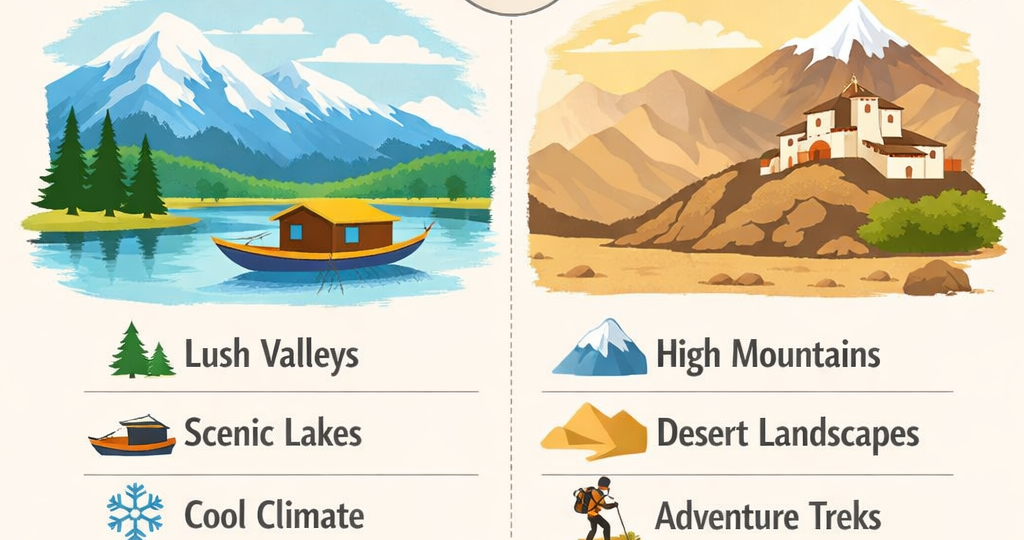
Kashmir seduces you with its softness: flowering meadows, walnut-wood houseboats, saffron fields, and the kind of unhurried warmth that makes you want to linger. Ladakh, on the other hand, hits you like altitude itself — sudden, overwhelming, and impossible to forget.
This guide, crafted by the expert team at JKL Travels with over two decades of on-ground experience in Jammu, Kashmir, and Ladakh, breaks down every dimension of both destinations — so you can stop guessing and start packing.
Kashmir vs. Ladakh: Quick Comparison at a Glance
Before we go deep, here’s a snapshot to orient your thinking:
| Feature | Kashmir | Ladakh |
| Altitude | 1,600–2,700 m | 3,500–5,600 m |
| Best Season | March – November | June – September |
| Landscape | Green valleys, lakes, forests | High-altitude desert, rocky passes |
| Best For | Families, honeymoons, culture | Bikers, trekkers, adventurers |
| Avg. Daily Budget | ₹3,000 – ₹5,000 | ₹5,000 – ₹8,000 |
| Acclimatization | Not required | Mandatory (24–48 hrs in Leh) |
| Nearest Airport | Srinagar (SXR) | Leh (IXL) |
| Cultural Flavor | Sufi, Mughal, Kashmiri | Tibetan Buddhist |
| Difficulty Level | Easy | Moderate – Challenging |
Now, let’s unpack each of these dimensions — because the devil, as always, is in the detail.
1. The Landscape: Lush Poetry vs. Raw Drama
Kashmir: Where the Earth Turns Green and Gentle
Stand at the edge of Nagin Lake at dawn and you’ll understand why Mughal emperors abandoned their empires to live here. Kashmir’s landscape is layered and lush — emerald meadows melt into pine forests, apple orchards frame snow-dusted peaks, and rivers thread through valleys so green they look painted.
The sensory experience of Kashmir changes with every season. In spring, the Indira Gandhi Tulip Garden in Srinagar — Asia’s largest tulip garden — erupts into a mosaic of over 1.5 million flowers across 64 varieties. In summer, the meadows of Gulmarg and Pahalgam are carpeted in wildflowers at altitudes between 2,400 and 2,800 metres. In autumn, the chinar trees ignite in amber and crimson, and in winter, the valley pulls on a white quilt that transforms Gulmarg into one of Asia’s finest ski destinations.
Key Landscape Highlights in Kashmir:
- Dal Lake and Nagin Lake — iconic shikara rides through floating gardens and wooden houseboats
- Gulmarg — gondola rides to one of the world’s highest cable car stations at 3,979 metres
- Pahalgam — pine-fringed valleys and the Lidder River (note: Baisaran Meadow, Aru Valley, and Betaab Valley are gradually reopening in 2026 after a security review; always confirm current access with your operator before visiting)
- Sonamarg — the ‘Meadow of Gold’, glaciers, and the gateway to Ladakh
- Yusmarg and Doodhpathri — quieter, off-the-beaten-track meadows worth exploring
Ladakh: Where Earth Feels Like Another Planet
Fly into Leh on a clear morning and you’ll press your face against the aircraft window. Nothing prepares you for what Ladakh looks like from the air — a vast, alien canvas of brown and ochre mountains, ribboned with rivers of impossible turquoise, occasionally punctuated by a burst of prayer flags fluttering at the edge of a monastery cliff.
Ladakh’s landscape is defined by extremes. It is simultaneously one of the driest and highest inhabited regions on earth — a cold desert perched between 3,500 and 5,600 metres above sea level, where the air is thin, the sky is impossibly blue, and the silence is the loudest thing you’ll hear.
Key Landscape Highlights in Ladakh:
- Pangong Tso — the 134-km-long high-altitude lake (70% of which lies in Tibet) that changes colour from turquoise to midnight blue through the day
- Nubra Valley — accessible via Khardung La (one of the world’s highest motorable passes at 5,359 metres), where double-humped Bactrian camels roam sand dunes
- Zanskar Valley — remote, raw, and dramatic, perfect for serious trekkers
- Thiksey Monastery, Diskit Monastery, Hemis — ancient gompa complexes perched theatrically on cliffsides
- Tso Moriri and Tso Kar — quieter, less-visited high-altitude lakes that rival Pangong in beauty
2. Weather and Best Time to Visit: When Should You Go?
Kashmir: A Near Year-Round Destination
One of Kashmir’s great advantages over Ladakh is its accessibility across most of the year. The valley sits at a comfortable 1,600 to 2,700 metres — high enough to be cool and refreshing, low enough to avoid the altitude challenges that come with Ladakh.
Spring (March to May)
March and April are arguably Kashmir’s most beautiful months. The tulip festival draws visitors from across the world, temperatures hover between 10°C and 22°C, and the valley is electric with new growth. Book accommodations early — this is a popular window.
Summer (May to August)
The peak tourist season, and for good reason. Temperatures stay pleasantly cool (15°C to 30°C), all major sights are accessible, and family vacations thrive. If you’re planning a honeymoon or a family trip with children or elderly parents, this is your window.
Autumn (September to October)
A hidden gem of a season. The chinar trees blaze with colour, crowds thin, and hotel rates soften. Delhi to Srinagar return flights typically run around ₹9,000 to ₹14,000 in October — notably cheaper than peak summer prices.
Winter (December to February)
Gulmarg in winter is a ski destination of international calibre. Snowfall transforms the valley, and for those who don’t mind the cold (temperatures can drop to -10°C), the offseason rates and snow-draped landscapes make it a wonderfully romantic escape.
Ladakh: A Narrow but Brilliant Window
Ladakh’s accessibility is strictly seasonal, and this is non-negotiable. The two main road arteries — the Srinagar–Leh Highway and the Manali–Leh Highway — remain closed from November through April or early May due to heavy snowfall. Even the Zojila Pass connecting Srinagar to Leh was kept open only until January 6, 2025 before closing for 68 days in the most recent winter season.
Peak Season: June to September
This is when Ladakh truly opens for business. Pangong Tso is reachable, Nubra Valley blooms with sea buckthorn, the Hemis Festival (usually June/July) fills the monastery courtyards with masked dances, and the high passes are passable by road. Temperatures range from 10°C to 20°C during the day, though nights can still be cold — carry layers regardless of the month.
Shoulder Season: May and October
May sees roads gradually opening but some passes may still be closed or unpredictable. October offers golden landscapes and fewer crowds, but plan to leave before mid-October — passes begin closing again and weather turns fast.
Winter Adventure: January to February (For the Hardy Only)
Leh is accessible only by air in winter. The famous Chadar Trek — a multi-day walk on the frozen Zanskar River — takes place in January and February and is considered one of India’s most extreme and spectacular trekking experiences. Not for casual travelers.
3. Safety Update 2026: What You Need to Know Before You Book
This is a topic we address directly and honestly, because it matters.
Kashmir: Stable, Safe, and Welcoming in 2026
Kashmir’s security situation in 2026 is stable across major tourist circuits. Srinagar, Gulmarg, Sonamarg, and Pahalgam are all open and actively welcoming visitors, with enhanced security deployment, tourist police helplines (8899941010 / 8899931010), and CCTV surveillance in high-footfall areas.
After the tragic April 2025 incident at Baisaran Meadow in Pahalgam, authorities temporarily suspended access to several sites. As of February 2026, the J&K administration has officially reopened 14 previously closed tourist destinations following a detailed security review involving police, intelligence, and civil authorities. Pahalgam town is open, though individual site access (Baisaran, Aru Valley, Betaab Valley) should be confirmed with your tour operator before arrival.
JKL Travels recommends: Always travel with a registered, experienced operator in Kashmir, stay within the established tourist circuit, and check the latest government advisories at the official J&K Tourism website before departure.
Ladakh: Secure and Well-Managed
Ladakh is politically and security-wise stable for tourists. The primary challenges are geographical, not political — altitude, unpredictable weather, and road conditions. Inner Line Permits are required for areas near the border, including Pangong and Nubra Valley; these are easily obtained online or in Leh through registered operators.
4. Culture and Cuisine: Two Worlds Within One Border
Kashmir: Where Sufism, Craft, and Hospitality Define Every Moment
Kashmir’s cultural identity runs deep. The valley has been a meeting point of Persian, Central Asian, and Indian influences for centuries, producing a civilisation renowned for its artistry and its warmth. A walk through Srinagar’s old city takes you past master wood carvers, weavers working pashmina looms, and papier-mâché artisans painting intricate patterns that have remained unchanged for 400 years.
The wazwan — a traditional Kashmiri feast that can include up to 36 courses — is considered one of the most elaborate culinary traditions in South Asia. Rogan Josh, Gushtaba, Rista, and Yakhni are not merely dishes; they are cultural statements. Pair them with Kashmiri Kahwa (green tea with saffron, cardamom, and rose petals) or the salty, bubbly Noon Chai for an experience your palate will remember long after you return home.
Cultural Experiences Not to Miss in Kashmir:
- A shikara ride at sunset on Dal Lake, weaving through floating vegetable markets
- A visit to the 16th-century Shah Hamdan Mosque and the old Khanqah in Srinagar
- Shopping at the Suffering Moses emporium or the Polo View Market for authentic Kashmiri handicrafts
- A traditional wazwan dinner hosted by a local family (your JKL Travels guide can arrange this)
- The Srinagar Flower Show and Tulip Festival in March-April
Ladakh: Ancient Monasteries, Buddhist Festivals, and Slow Living
Step off the plane in Leh and the first thing you’ll notice — apart from the thinness of the air — is the silence. Ladakh operates at its own pace, shaped by centuries of Tibetan Buddhist tradition. The landscape itself feels sacred: every mountain pass is marked with prayer flags, every hilltop monastery was built by monks who chose these heights deliberately.
The Hemis Festival, usually held in June or July, is Ladakh’s most spectacular cultural celebration — a two-day masked dance performance (Cham) in the courtyard of the Hemis Monastery, attended by monks and thousands of visitors. The Losar Festival (Tibetan New Year) in winter and the Ladakh Festival in September are equally worthwhile.
Ladakhi food is practical and warming — designed for bodies working at altitude in cold weather. Thukpa (noodle soup), Momos (steamed dumplings), Skyu (a hearty pasta stew), and Butter Tea are staples. Leh’s Main Bazaar also has excellent cafés offering everything from wood-fired pizza to excellent espresso, thanks to the town’s growing international tourism.
5. Adventure Activities: Light Thrills vs. Full-Throttle Expeditions
Kashmir: Comfortable Adventure with a Capital ‘C’
Kashmir is not a passive destination — there’s plenty to do for those who like to be active. But the adventures here are curated for comfort, and that’s not a criticism. Skiing on Gulmarg’s slopes is world-class; the Gulmarg Gondola, operating in two phases up to 3,979 metres, offers access to some of the finest off-piste terrain in Asia. River rafting on the Lidder and Sind rivers, treks through the Pahalgam valleys, horse riding across Gulmarg’s meadows — these are real adventures, accessible to most fitness levels.
Adventure Activities in Kashmir:
- Skiing and snowboarding in Gulmarg (December to March) — one of Asia’s top ski destinations
- Gondola rides to Phase II at 3,979 m — stunning Himalayan panoramas
- River rafting on the Lidder River in Pahalgam — Grade 2 to 3 rapids
- Trekking routes including Tarsar Marsar, Kashmir Great Lakes, and Sonamarg to Vishansar
- Camping at Betaab Valley and Chandanwari — check current access status with your operator
- Angling and trout fishing on the Bringi and Lidder rivers
Ladakh: Go Big or Stay Home
Ladakh is India’s adventure capital, full stop. The challenges are real — the altitude, the distances, the unpredictability of weather — but so are the rewards. A road trip on the Manali–Leh Highway, threading through five high passes over 4,500 metres, is widely considered one of the world’s great road journeys. The Zanskar River rafting expedition — navigating Class 4 and 5 rapids through a sheer-walled canyon — is the kind of experience that appears on once-in-a-lifetime lists.
Adventure Activities in Ladakh:
- Royal Enfield or adventure bike expeditions on the Manali-Leh Highway (June to September only)
- High-altitude trekking — Markha Valley, Stok Kangri, Sham Valley, Snow Leopard Trek
- Zanskar River rafting — Class 4 to 5 rapids through one of the world’s deepest gorges
- Chadar Trek on the frozen Zanskar River (January to February — extreme, unforgettable)
- ATV and mountain biking trails around Leh and Nubra
- Double-humped Bactrian camel safaris at Hunder Sand Dunes in Nubra Valley
- Stargazing at Hanle Observatory — one of the world’s highest altitude observatories
6. Health and Acclimatization: Know Before You Go
Kashmir: Easy on the Body
At 1,600 to 2,700 metres, Kashmir sits at an altitude that most healthy adults handle without any preparation. Breathing is normal, sleep is comfortable, and activities are unrestricted from day one. This makes Kashmir the right choice for families traveling with young children, senior travelers, or anyone with a pre-existing health condition. No altitude medication is needed in typical circumstances.
Ladakh: Respect the Altitude — It Is Non-Negotiable
Leh sits at 3,524 metres. Pangong Tso is at 4,350 metres. Khardung La is at 5,359 metres. Acute Mountain Sickness (AMS) is a real risk and affects even fit, experienced travelers — it does not discriminate on age or fitness level.
JKL Travels’ Standard Acclimatization Protocol for Ladakh:
- Rest completely for the first 24 to 48 hours after arriving in Leh — no sightseeing, no exertion
- Drink at least 3–4 litres of water daily; avoid alcohol for the first 48 hours
- Eat light meals — heavy, greasy food strains the body at altitude
- Ascend gradually — do not rush to Pangong or Khardung La on day two
- Consult your doctor about Acetazolamide (Diamox) before travel if you have a history of altitude sensitivity
- Know the symptoms of AMS: severe headache, nausea, loss of appetite, dizziness, or confusion — and descend immediately if symptoms worsen
A note from our medical advisors: Flying directly from a low-altitude city to Leh is the fastest way to cause altitude sickness. The Srinagar–Leh Highway route is recommended for first-timers — the gradual ascent gives your body time to adjust.
7. Budget Planning: What Will Your Trip Actually Cost?
Kashmir: India’s Most Rewarding Value-for-Money Mountain Destination
Kashmir offers exceptional value. A comfortable mid-range trip — covering a well-appointed hotel or houseboat on Dal Lake, private transport, meals at good local restaurants, and entry to all major sights — typically costs ₹3,000 to ₹5,000 per person per day. Budget backpackers can travel for less; luxury seekers will find Heritage hotels and premium houseboat experiences that justify a higher spend.
Sample Budget Breakdown for 7-Night Kashmir Trip:
- Accommodation (heritage hotel or deluxe houseboat): ₹3,500–₹8,000 per night
- Return flights Delhi–Srinagar: ₹6,000–₹14,000 (off-peak to peak)
- Private cab for sightseeing: ₹2,000–₹3,500 per day
- Meals (local restaurants and dhabas): ₹500–₹1,500 per day
- Gondola ride (Gulmarg Phase I + II): ₹900–₹1,800
- Shikara ride on Dal Lake: ₹500–₹1,000 per hour
Ladakh: Higher Cost, Higher Reward
Ladakh costs more — logistics in a remote, high-altitude region always do. Fuel is expensive, accommodation options are limited outside Leh and a few key spots, and permit fees add up. Budget ₹5,000 to ₹8,000 per person per day for a comfortable trip. A 6 to 7-day budget trip can be done for ₹25,000 to ₹35,000; fully-equipped luxury camping and premium vehicles push this to ₹1 lakh and above.
JKL Travels’ all-inclusive curated Ladakh packages start from ₹42,999 per person, covering accommodation, transport, permits, and guided sightseeing.
Additional Costs to Plan For in Ladakh:
- Inner Line Permits for Pangong and Nubra: ₹200–₹500 per person (easily arranged through your operator)
- Bike rental (Royal Enfield): ₹1,500–₹2,500 per day
- Camp accommodation near Pangong: ₹3,500–₹8,000 per night (varies wildly by season)
- Long-distance taxis: significantly more expensive than Kashmir due to fuel and distance
8. Who Is Each Destination Right For?
Choose Kashmir If You Are…
- Traveling with family including children under 12 or senior members
- Planning a honeymoon that balances romance with relaxation
- A first-time Himalayan traveler testing the waters
- Someone who values culture, cuisine, and craft as much as scenery
- Planning to travel between October and March when Ladakh roads are closed
- Working with a tighter budget without compromising on beauty or experience
Choose Ladakh If You Are…
- A solo traveler, biker, or adventure enthusiast
- Someone who has already done Kashmir and wants a completely different experience
- A photographer chasing dramatic, otherworldly landscapes
- A trekking enthusiast looking for serious high-altitude routes
- Drawn to Buddhist culture, monasteries, and spiritual landscapes
- The kind of traveler who prefers raw over refined, remote over resort
The JKL Travels Verdict: Why Not Both?
If your time allows — and we’d encourage you to make it allow — the ideal Himalayan itinerary combines both destinations. Many of our most satisfied guests fly into Srinagar, spend 4–5 days in Kashmir, then travel the scenic Srinagar–Leh Highway (a two-day drive with an overnight in Sonamarg or Kargil) into Ladakh for another 5–7 days. The contrast is revelatory — you move from the lushest valleys on earth into its most dramatic high-altitude desert in the span of a journey, and you understand, for the first time, the full scale of what the Himalayas actually are.
Together, Kashmir and Ladakh don’t just show you two destinations — they show you two completely different faces of the same mountain world. And once you’ve seen both, you’ll spend the rest of your life planning a return.
PLAN YOUR TRIP WITH JKL TRAVELS
With 20+ years of on-ground expertise in Jammu, Kashmir, and Ladakh, JKL Travels designs itineraries that fit your travel style, budget, and season. Whether it’s a 7-night Kashmir honeymoon, a 10-day Ladakh bike expedition, or a combined Kashmir–Ladakh grand journey, our local team in Srinagar and Leh handles every detail.
Contact JKL Travels | www.jkltravels.com
© 2026 JKL Travels | This article is for informational purposes. Ground conditions, access permissions, and safety advisories in Kashmir and Ladakh can change. Always verify current status with official sources and your tour operator before travel.